Organic Compounds Containing Oxygen: Chemistry | JEE Main
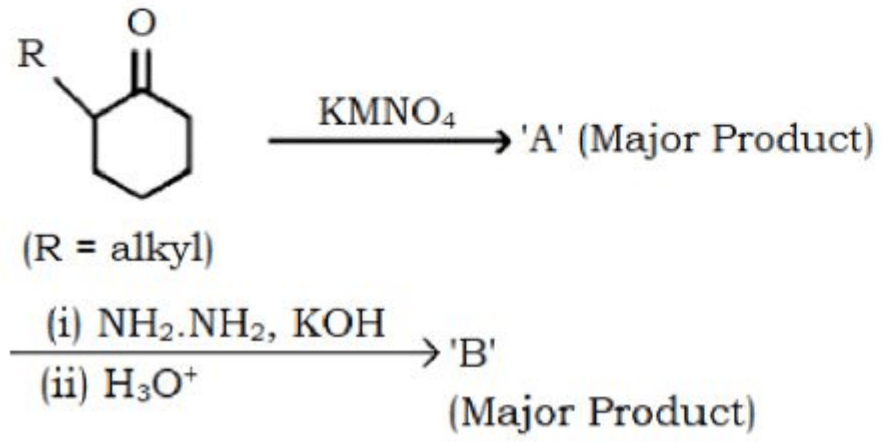
'A' and 'B' in the below reactions are :
Your answer stays private
What feels right?
Hint 1 of 2
What product is formed when toluene is treated with NBS in the presence of light/heat (Reaction A)?
No score. Commit to your first instinct. We’ll show what your mind noticed and what it missed.
Step-by-step solutionView
Correct answer
Free radical bromination of toluene with NBS or Br2/light gives benzyl bromide (A), while FeBr3-catalyzed bromination gives p-bromotoluene, which upon nitration yields 4-bromo-2-nitrotoluene (B).
Option analysis
Why each option works or fails
A ·
Belief that NBS/light functionalizes the aromatic ring instead of the benzylic position, or misidentifying the directing effects in the second pathway. Recognize that NBS under photochemical conditions selectively performs benzylic halogenation via a free-radical mechanism rather than electrophilic ring substitution.
B ·
Confusing the selectivity of benzylic free-radical bromination with ring bromination, or getting the regiochemistry of nitration on p-bromotoluene reversed. Differentiate between radical conditions (NBS/hν giving benzylic substitution) and Lewis acid conditions (Br2/FeBr3 giving ring bromination directed para to the methyl group).
C ·
Assuming that bromination with Br2/FeBr3 directs meta or that the nitro group enters meta to both substituents. Remember that in p-bromotoluene, the stronger activating methyl group directs incoming electrophiles ortho to itself (position 2), giving 4-bromo-2-nitrotoluene.
D ·
None. This is the correct set of products. Reaction (A) yields benzyl bromide via benzylic radical substitution with NBS/hν. Reaction (B) yields 4-bromo-2-nitrotoluene because bromination first forms p-bromotoluene, and subsequent nitration is directed ortho to the activating methyl group.
Reviewed route
Solution
StepWorking
01identify
The reaction sequence involves the reduction of an ester or keto-ester derivative using NaBH4. This gives alcohol 'A'. Then, reaction with HBr gives substituted alkyl bromide 'B'.
02mechanism
NaBH4 acts as a selective hydride donor reducing the ketone/aldehyde/ester/halide carbonyl functionalities selectively. Specifically, NaBH4 reduces the carbonyl (ester/ketone group) to the corresponding secondary alcohol 'A' without altering the carboxylate skeleton.
03product
Product 'A' is the alcohol. Reaction of secondary alcohol 'A' with HBr leads to nucleophilic substitution via protonation followed by bromide ion attack to form bromo-derivative 'B'.
✓verify
Matching with Option (3): 'A' has the reduced hydroxy functionality and 'B' has the substituted bromo group, consistent with standard organic transformations.
✓ Source and academic review↓
Question type
Single correct
Exam relevance
JEE Main · Chemistry
Concepts assessed
Chemistry
Academic status
Reviewed by official_key
Source
pyq
Editorial review
7 September 2026
Quick checks
Students also ask
Does NaBH4 reduce esters readily under normal conditions?
NaBH4 selectively reduces ketones and aldehydes much faster than esters, but in functionalized substrates, the ketone carbonyl is reduced cleanly to a secondary alcohol.