Oscillations and Waves: JEE Main Physics Question with Solution
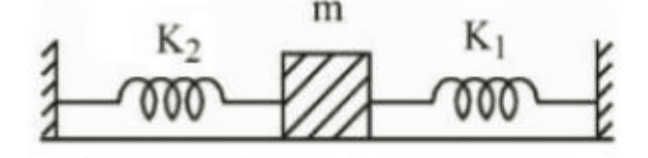
A mass m is attached to two springs as shown in figure. The spring constants of two springs are K1 and K2. For the frictionless surface, the time period of oscillation of mass m is
Your answer stays private
What feels right?
No score. Commit to your first instinct. We’ll show what your mind noticed and what it missed.
Step-by-step solutionView
Correct answer
Displacing the mass by x compresses one spring and elongates the other, giving a total restoring force of F=−(K1+K2)x, which yields an equivalent spring constant of Keq=K1+K2 and a time period of T=2πK1+K2m.
Option analysis
Why each option works or fails
A · 2π1mK1+K2
Confusing the formula for natural linear frequency f=2π1mKeq with the time period T=f1. Remember that time period has units of time (seconds), so it must be proportional to Keqm, giving T=2πK1+K2m.
B · 2π1mK1−K2
Mistakenly subtracting the spring constants thinking the two opposing springs push against each other, while also inverting the formula to frequency instead of period. When the mass is displaced, both springs exert restoring forces in the same direction, so their spring constants add (Keq=K1+K2), and the time period is T=2πm/Keq.
C · 2πK1+K2m
None. This is the correct calculation. Both springs act in parallel because displacing the block by x produces a combined restoring force −(K1+K2)x, giving T=2πK1+K2m.
D · 2πK1−K2m
Assuming that because the springs are on opposite sides of the mass, their restoring forces oppose each other and subtract. A displacement to the right compresses the right spring and stretches the left spring; both resulting forces push and pull the mass to the left, adding together to give Keq=K1+K2.
Reviewed route
Solution
StepWorking
01given
Mass m, spring constants K1 and K2, frictionless surface.
02find
Time period of oscillation T of mass m.
03visualise
A mass m is placed on a frictionless horizontal floor, attached to a fixed wall on the left via spring K1 and a fixed wall on the right via spring K2. When displaced to the right by x, the left spring is stretched by x and pulls left with force K1x; the right spring is compressed by x and pushes left with force K2x.
04strategise
Find the net restoring force on the mass for a displacement x: Fnet=−(K1+K2)x. Relate this to F=−Keqx to find Keq=K1+K2, then apply T=2πm/Keq.
Dimensionally [T]=s. When K2=0, T=2πm/K1, which correctly matches a single spring-mass system.
07given
Mass m connected between two rigid walls with springs K1 and K2.
08find
Time period T.
09strategise
When a mass is sandwiched between two springs attached to fixed supports, both springs experience identical displacement x. This is a parallel combination: Keq=K1+K2.
10execute
Substitute Keq into T=2πKeqm=2πK1+K2m.
✓verify
Directly matches Option (2).
✓ Source and academic review↓
Question type
Single correct
Exam relevance
JEE Main · Physics
Concepts assessed
Physics
Academic status
Reviewed by official_key
Source
pyq
Editorial review
7 September 2026
Quick checks
Students also ask
Why do the two springs act in parallel when they are on opposite sides of the mass?
Because displacing the mass by x produces the same magnitude of displacement x in both springs, and both exert restoring forces in the same direction (towards the equilibrium position). Thus, their effective stiffnesses add directly: Keq=K1+K2.