Organic Compounds Containing Nitrogen: Chemistry | JEE Main
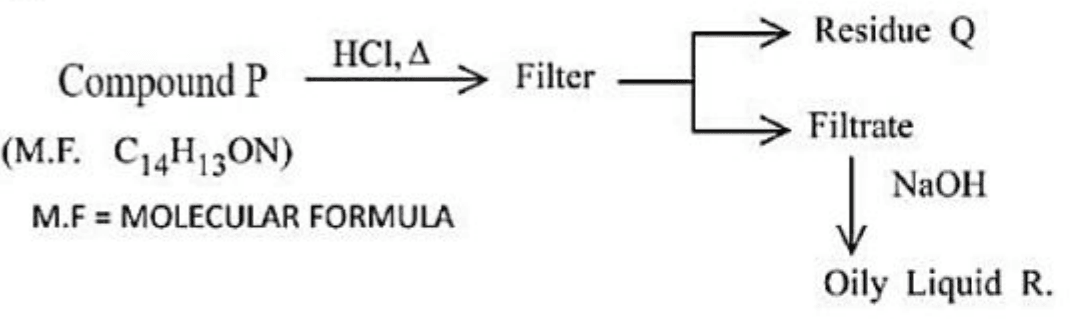
Compound P is neutral. Q gives effervescence with NaHCO3 while R reacts with Hinsbergs reagent to give solid soluble in NaOH. Compound P is
Your answer stays private
What feels right?
Hint 1 of 3
What functional group in Q is indicated by effervescence with aqueous NaHCO3?
No score. Commit to your first instinct. We’ll show what your mind noticed and what it missed.
Step-by-step solutionView
Correct answer
Compound P is a secondary amide that hydrolyzes to a carboxylic acid (effervescence with NaHCO₃) and a primary aliphatic amine (forms a base-soluble sulfonamide with Hinsberg's reagent).
Option analysis
Why each option works or fails
A ·
Believing that tertiary amides yield primary amines upon acidic hydrolysis. Acid hydrolysis of an N,N-disubstituted (tertiary) amide yields a secondary amine, which forms an alkali-insoluble sulfonamide with Hinsberg's reagent.
B ·
None. This is the correct structure. Hydrolysis of this monosubstituted amide produces a carboxylic acid (Q, active with NaHCO₃) and a primary aliphatic amine (R, reacts with Hinsberg's reagent to give an alkali-soluble sulfonamide).
C ·
Assuming an ester or wrong functional connectivity satisfies the nitrogen-based Hinsberg test requirement. Check functional group connectivity: an ester yields an alcohol instead of an amine, failing the Hinsberg test entirely.
D ·
Confusing the acyl and amine halves, leading to an aromatic amine whose resonance reduces nucleophilicity or forms an incompatible product set. Trace which fragment retains the carbonyl carbon as a carboxylic acid and which becomes the free primary amine.
Reviewed route
Solution
StepWorking
01identify
Analyze the given functional group test results: Hydrolysis of compound P gives Q and R. Q gives effervescence with NaHCO3, meaning Q is a carboxylic acid (-COOH). R reacts with Hinsberg's reagent to give a solid soluble in NaOH, meaning R is a primary amine (-NH2). Since P is neutral and hydrolyzes into a carboxylic acid and a primary amine, P is an amide (-CONH-).
02mechanism
Hydrolysis of an amide R'-CO-NH-R'' with H3O+ breaks the C-N amide bond. This yields the carboxylic acid R'-COOH (Q) and the amine salt R''-NH3+ (yielding R''-NH2, R).
Examine the connectivity in Option (1). P is N-(4-ethylphenyl)benzamide (Ph-CONH-C6H4-CH2CH3) or an equivalent benzamide/acetamide derivative. Option 1 represents Ph-CONH-C6H4-Et.
Upon hydrolysis, it yields Benzoic acid (Ph-COOH, Q). This acid reacts with NaHCO3 with CO2 effervescence. It also yields 4-ethylaniline (4-Et-C6H4-NH2, R), which is a 1° amine.
03product
Option 1 has the amide linkage correctly oriented such that hydrolysis yields Ph-COOH and p-ethylaniline. Both fragments match all functional test criteria (Q gives CO2 with NaHCO3; R is a 1° amine giving an alkali-soluble Hinsberg product).
✓verify
Check other options: Esters (if any) or secondary amine-forming amides (which would give Hinsberg products insoluble in NaOH) do not satisfy the criteria. Option (1) is the only structure that is neutral and hydrolyzes to a carboxylic acid and a 1° amine.
✓ Source and academic review↓
Question type
Single correct
Exam relevance
JEE Main · Chemistry
Concepts assessed
Chemistry
Academic status
Reviewed by official_key
Source
pyq
Editorial review
7 September 2026
Quick checks
Students also ask
Why does a 1° amine product from Hinsberg's reagent dissolve in NaOH?
The sulfonamide formed (R-NH-SO2-Ar) has an acidic hydrogen on the nitrogen atom. This nitrogen is attached to a strongly electron-withdrawing sulfonyl group. Aqueous NaOH deprotonates this hydrogen to form a water-soluble salt.