Organic Compounds Containing Oxygen: Chemistry | JEE Main
Given below are two statements, one is labelled as Assertion A and the other is labelled as Reason R.
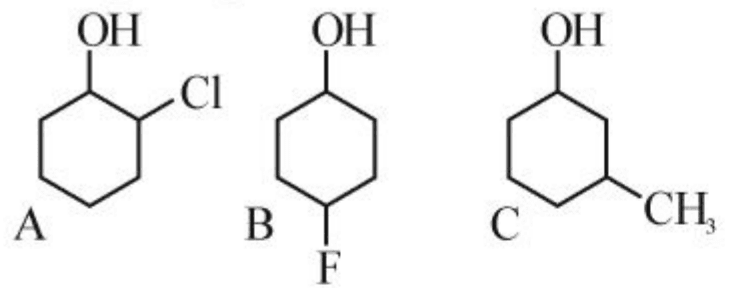
Assertion A : Order of acidic nature of the following compounds is A>B>C.
Reason R : Fluoro is a stronger electron withdrawing group than Chloro group.
In the light of the above statements, choose the correct answer from the options given below:
Your answer stays private
What feels right?
Hint 1 of 2
What primarily determines the relative magnitude of the electron-withdrawing inductive (-I) effect among carboxylic acid derivatives?
No score. Commit to your first instinct. We’ll show what your mind noticed and what it missed.
Step-by-step solutionView
Correct answer
Both Assertion A and Reason R are correct statements, but R does not explain A because the variation in acidity between A, B, and C depends on the distance and number of halogens, not the relative inductive strength of fluorine versus chlorine.
Option analysis
Why each option works or fails
A · A is false but R is true
Believing that compound A is not the most acidic because chlorine is less electronegative than fluorine, ignoring the dominant effect of distance. Recall that the inductive effect is strongly distance-dependent; substituents closer to the carboxylic acid group exert a much stronger stabilizing effect than substituents further away.
B · Both A and R are correct and R is the correct explanation of A
Assuming that because fluorine is more electronegative than chlorine, this fact alone accounts for the specific acidity sequence A > B > C across all three molecules. Check whether Reason R actually accounts for the specific structural differences between A, B, and C; here, the position and number of substituents change across the molecules, not just the halogen identity.
C · Both A and R are correct but R is NOT the correct explanation of A
None. This option correctly recognizes that both statements are true on their own merits, but the trend in Assertion A is driven primarily by distance and substituent count rather than halogen identity alone. Keep distinguishing between a statement being factually correct and that statement being the causal explanation for the given assertion.
D · A is true but R is false
Believing that chlorine exerts a stronger electron-withdrawing inductive effect than fluorine. Recall that electronegativity dictates the magnitude of the -I effect, making fluorine a stronger -I group than chlorine.
Reviewed route
Solution
StepWorking
01assertion_eval
Assess Assertion A: Compound A has a Cl group at the α-position (C2) of butanoic acid. Compound B has an F group at the β-position (C3). Compound C has an electron-donating methyl group.
Acidic strength increases with the magnitude of the -I effect. This effect stabilizes the carboxylate anion. The inductive effect falls off rapidly with distance. We follow the dnp rule (distance > number > power).
In A, Cl is at the α-position, which is closer to -COOH. In B, F is at the β-position, farther from -COOH. Thus, the -I effect felt at the carboxyl group is stronger in A than in B.
Compound C has a +I methyl group, which makes it the least acidic. Hence, the order of acidity is indeed A > B > C. Therefore, Assertion A is true.
02reason_eval
Assess Reason R: Fluorine is more electronegative than chlorine (electronegativity: F ≈ 4.0, Cl ≈ 3.0), meaning the inherent electron-withdrawing power (-I effect) of fluoro is indeed stronger than that of chloro. Therefore, Reason R is true as an independent statement.
✓link_test
Test causal link: Assertion A shows that A (with Cl) is more acidic than B (with F). If Reason R alone explained Assertion A, B would be more acidic than A. This is because F has a stronger -I power.
However, A is more acidic because distance overrides power. The -I group in A is at the α-position. In B, it is at the β-position.
Reason R is a true statement on its own. But it does not explain why A > B. The distance dependence of the inductive effect explains the order instead. Hence, R is NOT the correct explanation of A.
Hints that build this answer step by step
What primarily determines the relative magnitude of the electron-withdrawing inductive (-I) effect among carboxylic acid derivatives?
The number, proximity (distance) to the -COOH group, and electronegativity of the substituent.
Why is Reason R not the correct explanation for Assertion A?
Assertion A compares molecules with differing halogen positions and counts; Reason R only compares the intrinsic -I power of F versus Cl without accounting for distance.
Why is 2-chlorobutanoic acid more acidic than 3-fluorobutanoic acid if F is more electronegative?
Inductive effect is strongly distance-dependent. According to the DNP rule, Distance dominates over Number, which dominates over Power. An electron-withdrawing group at the α-position is closer to the carboxyl group. It stabilizes the conjugate base much more effectively than a stronger group at the β-position.