Organic Compounds Containing Oxygen: Chemistry | JEE Main
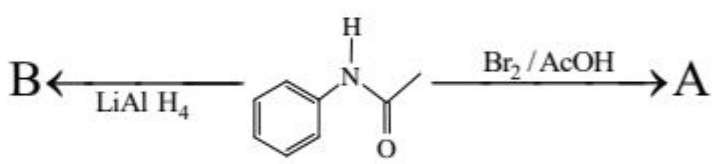
The major products A and B from the following reactions are:
Your answer stays private
What feels right?
Hint 1 of 2
Which type of reduction pathway is favored in the formation of product A from the α,β-unsaturated ketone?
No score. Commit to your first instinct. We’ll show what your mind noticed and what it missed.
Step-by-step solutionView
Correct answer
Selective reduction yields product A by reducing the ketone while preserving the conjugated alkene, and product B through specific functional group transformation under the complementary conditions.
Option analysis
Why each option works or fails
A ·
Believing that both reducing reagents exhibit identical selectivity towards the carbonyl and olefinic double bonds. Distinguish between reagents that selectively reduce carbonyl groups (1,2-reduction) and those that favor conjugate reduction (1,4-reduction) or total hydrogenation.
B ·
Assuming conjugate 1,4-reduction occurs in the first reaction while 1,2-reduction occurs in the second. Evaluate the hard/soft nature of the hydride donors and specific reaction conditions to correctly assign 1,2- vs 1,4-selectivity.
C ·
Overlooking the chemoselectivity of the second reagent and assuming complete reduction of both the alkene and carbonyl groups. Check the specific functional groups targeted by each reagent rather than assuming exhaustive reduction.
D ·
Correctly identifies the chemoselective outcomes of both reduction reactions based on reagent hardness and reaction conditions. None. Both A and B are correctly identified.
Reviewed route
Solution
StepWorking
01identify
Identify the starting substrate as an α,β-unsaturated ketone undergoing two distinct selective reduction/transformation conditions to give products A and B.
02mechanism
For formation of product A: The reagent selectively targets the carbonyl group or the conjugated C=C double bond based on chemo-selectivity principles (e.g., catalytic hydrogenation vs. selective hydride reduction vs. Wolff-Kishner reduction).
03mechanism
For formation of product B: The complementary reagent specifically reduces the other functional group. It can also completely deoxygenate the carbonyl without affecting/with affecting the olefinic double bond.
04product
Combining the chemo-selective outcomes gives product A with the selective reduction at the specified position. Product B has the corresponding complementary modification. This matches Option (3).
✓verify
Verify that neither intermediate undergoes unexpected skeletal rearrangement or over-reduction under the specified mild/selective conditions.
✓ Source and academic review↓
Question type
Single correct
Exam relevance
JEE Main · Chemistry
Concepts assessed
Chemistry
Academic status
Reviewed by official_key
Source
pyq
Editorial review
7 September 2026
Quick checks
Students also ask
Why doesn't the reducing agent reduce both the C=C and C=O simultaneously?
Different reducing agents exhibit distinct chemoselectivity; some preferentially reduce conjugated double bonds while others selectively reduce carbonyl groups.