Solutions: JEE Main Chemistry Question with Solution
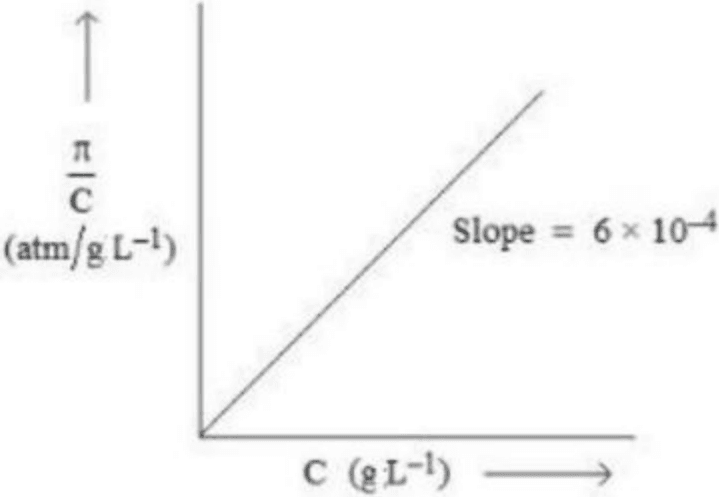
The osmotic pressure of solutions of PVC in cyclohexanone at 300K are plotted on the graph. The molar mass of PVC is gmol−1 (Nearest integer)
(Given : R=0.083LatmK−1mol−1 )
Your answer stays private
What feels right?
Hint 1 of 3
What relates the osmotic pressure Π (in atm) to polymer concentration C (in g L−1) and molar mass M (in g mol−1)?
No score. Commit to your first instinct. We’ll show what your mind noticed and what it missed.
Type the value - units or words beside it are fine.
Step-by-step solutionView
Correct answer
The molar mass of PVC is determined to be 41500 g mol−1 using the relation between the slope of the Π versus C plot and MRT.
Option analysis
Why each option works or fails
Reviewed route
Solution
StepWorking
01given
Temperature T=300 K, gas constant R=0.083 L atm K−1mol−1, and a linear plot of osmotic pressure π (in atm) versus mass concentration C=w/V (in g L−1) with slope m=6×10⁻⁴.
02find
The molar mass M of PVC in g mol−1.
03strategise
Osmotic pressure is given by van 't Hoff's law: π=CRT/M, where C=w/V is mass concentration. Plotting π against C gives a straight line through the origin with slope slope=MRT. Thus, M=slopeRT.
04execute
Substitute R=0.083, T=300, and slope=6×10⁻⁴ into M=slopeRT: M=6×10−40.083×300=6×10−424.9=41500 g mol−1
✓verify
A molar mass around 4.15×10⁴ g mol−1 is typical for a synthetic polymer like PVC.
Hints that build this answer step by step
What relates the osmotic pressure Π (in atm) to polymer concentration C (in g L−1) and molar mass M (in g mol−1)?
Π=MCRT, meaning the slope of Π versus C equals MRT
Given the plot passes through the origin and (C=50 g L−1,Π=3.0×10⁻² atm), what is the slope of the line?
6.0×10⁻⁴ atm L g−1
Using slope=MRT with R=0.083 L atm K−1mol−1 and T=300 K, what is the value of M?
41500 g mol−1
✓ Source and academic review↓
Question type
Numerical
Exam relevance
JEE Main · Chemistry
Concepts assessed
Chemistry
Academic status
Reviewed by official_key
Source
pyq
Editorial review
8 September 2026
Quick checks
Students also ask
Why does the slope equal RT/M instead of just RT?
The x-axis represents mass concentration in g/L (C=w/V), not molar concentration (n/V). Since n=w/M, we have π=(w/V)(RT/M)=C(RT/M), meaning the slope of π vs C is RT/M.