Organic Compounds Containing Oxygen: Chemistry | JEE Main
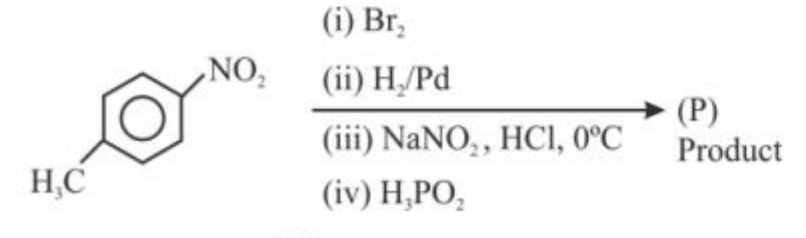
The product (P) formed from the following multistep reaction is :-
Your answer stays private
What feels right?
Hint 1 of 2
Which alkene isomer is predominantly formed upon acid-catalyzed dehydration in the intermediate step?
No score. Commit to your first instinct. We’ll show what your mind noticed and what it missed.
Step-by-step solutionView
Correct answer
The sequence undergoes addition and acid-catalyzed elimination to yield the more stable, conjugated alkene, followed by oxidative ozonolysis to form the dicarboxylic acid derivative shown in the correct option.
Option analysis
Why each option works or fails
A ·
Believing that elimination yields the less substituted (Hofmann/kinetic) alkene before ozonolysis cleavage. Under thermodynamic acid-catalyzed conditions, the elimination proceeds toward the more stable, Zaitsev/conjugated alkene.
B ·
Incorrectly assigning the cleavage products of the ozonolysis step or retaining the wrong carbonyl oxidation state. Follow the cleavage of the specific carbon-carbon double bond systematically and ensure the terminal/internal positions oxidize to the correct carbonyl/carboxylic acid functionalities.
C ·
Selecting the product derived from an endocyclic rather than exocyclic or alternatively conjugated double bond. Identify the most substituted, fully conjugated alkene intermediate before performing the double bond cleavage.
D ·
None. This is the correct product resulting from stable intermediate alkene formation followed by oxidative cleavage. Correctly determined the most stable alkene via Zaitsev elimination and cleaved it to yield the corresponding dicarbonyl/acid product.
Reviewed route
Solution
StepWorking
01identify
The reaction sequence starts with a 6-membered cyclic bromohydrin (trans-2-bromocyclohexan-1-ol), which undergoes: (i) intramolecular epoxide formation with strong base K+t-BuO−, (ii) regioselective epoxide ring-opening with Grignard reagent CH3MgBr followed by H3O+, and (iii) acid-catalyzed dehydration with H2SO4/Δ.
02mechanism
Step 1: t-BuO− deprotonates the hydroxyl group, forming an alkoxide that attacks the adjacent carbon bearing bromine via an intramolecular SN2 mechanism to yield cyclohexene oxide (epoxide).
03mechanism
Step 2: Methylmagnesium bromide (CH3MgBr) attacks the symmetric cyclohexene oxide ring via nucleophilic ring-opening, and upon protonation with H3O+, yields trans-2-methylcyclohexan-1-ol.
04mechanism
Step 3: Heating with H2SO4 protonates the alcohol group followed by loss of H2O to generate a secondary carbocation at C1. A 1,2-hydride shift occurs to form the more stable tertiary carbocation at C2 (bearing the methyl group). Subsequent loss of a proton generates the most substituted and thermodynamically stable alkene, 1-methylcyclohexene (Saytzeff product).
05product
The major product formed is 1-methylcyclohexene, which corresponds to option (3).
✓verify
The product 1-methylcyclohexene is a trisubstituted alkene, which is thermodynamically favored over 3-methylcyclohexene or methylenecyclohexane.
✓ Source and academic review↓
Question type
Single correct
Exam relevance
JEE Main · Chemistry
Concepts assessed
Chemistry
Academic status
Reviewed by official_key
Source
pyq
Editorial review
7 September 2026
Quick checks
Students also ask
Why does the double bond form at the methyl-substituted carbon rather than the adjacent CH2?
Carbocation rearrangement occurs via a 1,2-hydride shift to form a stable tertiary carbocation, leading to the more substituted (Saytzeff) alkene, 1-methylcyclohexene.