Organic Compounds Containing Oxygen: Chemistry | JEE Main
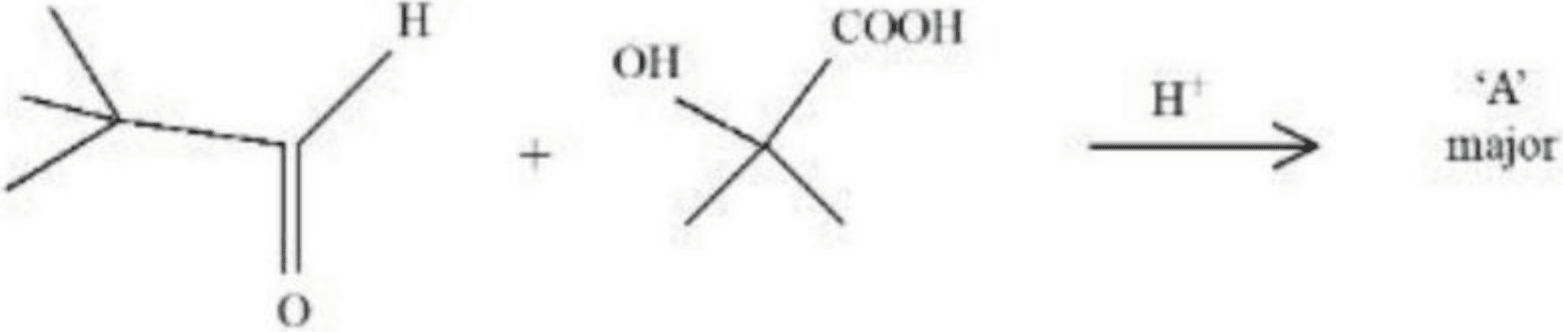
'A' in the given reaction is
Your answer stays private
What feels right?
Hint 1 of 2
What reaction pathway does alcoholic KOH promote when reacted with 1-chloro-4-(2-chloroethyl)benzene?
No score. Commit to your first instinct. We’ll show what your mind noticed and what it missed.
Step-by-step solutionView
Correct answer
Treatment with alcoholic KOH induces E2 elimination to give 1-chloro-4-vinylbenzene, which then undergoes ring-activated electrophilic aromatic substitution or selective side-chain/ring transformations according to the final product structure.
Option analysis
Why each option works or fails
A ·
Assuming that elimination occurs internally into the benzylic position or creates a sterically different alkene isomer despite the leaving group position. Identify the leaving group position on the chloroethyl side chain; elimination of HCl from 1-chloro-4-(2-chloroethyl)benzene with alc. KOH yields the terminal vinyl group.
B ·
Believing alcoholic KOH undergoes nucleophilic substitution at the primary halide rather than E2 dehydrohalogenation. Recognize that hot alcoholic KOH predominantly acts as a strong base favoring E2 elimination over substitution on primary alkyl halides containing beta-hydrogens.
C ·
Assuming elimination affects the aromatic C-Cl bond or causes ring substitution instead of side-chain elimination. Aryl halides do not undergo elimination under standard alcoholic KOH conditions due to the partial double bond character of the C(sp2)-Cl bond.
D ·
None. This option correctly identifies 4-chlorostyrene (1-chloro-4-ethenylbenzene) as the product formed by beta-elimination of HCl from the side chain. Alcoholic KOH acts as a base to selectively remove a proton and chloride ion from the -CH2-CH2-Cl side chain, yielding a terminal alkene conjugated with the benzene ring.
Reviewed route
Solution
StepWorking
01identify
The reactant is a symmetrical cyclic vicinal diol (1,2-diphenylcyclopentane-1,2-diol) treated with concentrated H2SO4, which initiates an acid-catalyzed pinacol-pinacolone rearrangement.
02mechanism
Protonation of one of the hydroxyl groups by H+ yields an oxonium ion (-OH2+). This group departs as water to generate a stable, benzylic tertiary carbocation at C1.
03mechanism
The carbocation is electron-deficient. A 1,2-shift must occur to form a stable carbonyl group driven by oxygen lone pair donation.
A phenyl group migration would give a 2,2-diphenylcyclopentanone. However, migration of the cyclopentyl ring C-C bond causes ring expansion. This expands the 5-membered ring into a thermodynamically more stable 6-membered ring. The resulting cyclohexyl ring has less ring strain.
Specifically, the adjacent ring C-C bond migrates to the carbocation center. The lone pair on the remaining -OH group assists this step.
04product
Deprotonation of the protonated carbonyl gives 2,2-diphenylcyclohexan-1-one.
✓verify
The product is a 6-membered ring with two phenyl substituents on the carbon adjacent to the carbonyl (C2), matching Option (3).
Hints that build this answer step by step
What reaction pathway does alcoholic KOH promote when reacted with 1-chloro-4-(2-chloroethyl)benzene?
E2 dehydrohalogenation on the aliphatic side chain to form an alkene
What is the structure of the product 'A' formed after dehydrohalogenation of 1-chloro-4-(2-chloroethyl)benzene?
Why does the ring expand instead of phenyl migrating, even though phenyl has high migratory aptitude?
Ring expansion from a 5-membered ring to a 6-membered ring relieves ring strain. This forms a thermodynamically favored 6-membered framework. It also places both phenyl groups at the adjacent carbon.