Organic Compounds Containing Oxygen: Chemistry | JEE Main
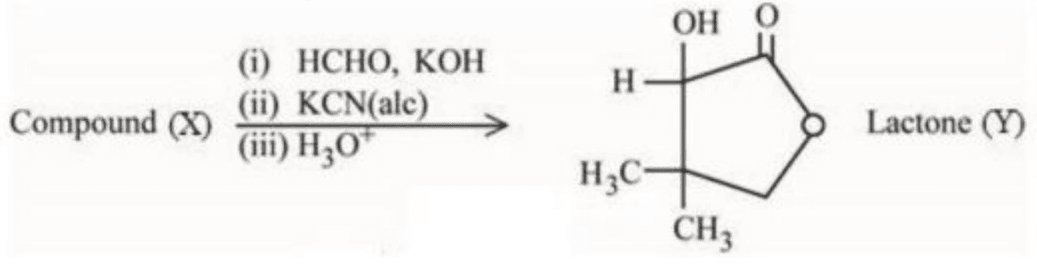
Compound (X) undergoes following sequence of reactions to give the Lactone (Y).
Compound (X) is
Your answer stays private
What feels right?
Hint 1 of 2
What functional transformations occur when an aldehyde reacts with KCN/H+ followed by acidic hydrolysis (H3O+)?
No score. Commit to your first instinct. We’ll show what your mind noticed and what it missed.
Step-by-step solutionView
Correct answer
Compound (X) is a 4-carbon chain containing both a hydroxyl group at one end and a carbonyl group at the other, specifically 4-hydroxybutanal, which upon nucleophilic addition of cyanide and subsequent acidic hydrolysis cyclizes to form the given 5-membered lactone.
Option analysis
Why each option works or fails
A ·
Believing the ring size of the product requires an initial cyclic reactant, ignoring the open-chain pathway via intramolecular lactonization. Recognize that a 5-membered lactone ring commonly forms via intramolecular attack of a hydroxy group on a carboxylic acid derived from an open-chain hydroxy-aldehyde.
B · H2C−CH2−CH2−CH2−CHO∣OH
Miscounting the total number of carbon atoms introduced by cyanide addition, leading to a 6-membered or larger ring instead of the 5-membered lactone shown. Count the carbons in the lactone ring: the ring has 4 carbon atoms and 1 oxygen atom, plus cyanide introduces the carbonyl carbon (C1), meaning the starting aldehyde backbone must have 4 carbons with the −OH at carbon-4.
C · H2C−CH2−CHO∣CH3
Selecting a simple hydrocarbon aldehyde with no pendant hydroxyl nucleophile required for lactone formation. Remember that lactones are cyclic esters; an intramolecular alcohol group is required in starting material (X) to react with the generated carboxylic acid group.
D ·
None. This is the correct structure. 4-hydroxybutanal reacts with KCN/H+ to yield a 5-carbon hydroxynitrile, which upon acidic hydrolysis gives a γ-hydroxy acid that spontaneously cyclizes to a γ-butyrolactone derivative.
Reviewed route
Solution
StepWorking
01identify
The reaction sequence involves: (1) Grignard addition of CH3MgBr (or cyclic ketone addition) followed by hydrolysis with dilute acid, resulting in intramolecular esterification (lactonization) to yield a 5-membered cyclic ester (γ-lactone).
02mechanism
Opening lactone (Y) gives a 4-hydroxycarboxylic acid containing a tertiary alcohol: (CH3)2C(OH)−CH2−CH2−COOH. Under acidic conditions, this γ-hydroxy acid cyclizes with loss of H2O to give the 5-membered lactone (Y).
03mechanism
The tertiary alcohol group −C(OH)(CH3)2 is formed by adding CH3MgBr to a methyl ketone: −COCH3+CH3MgBrH3O+−C(OH)(CH3)2. The carboxylic acid group −COOH comes from the acidic hydrolysis of a nitrile group: −CNH3O+−COOH.
04product
Combining the ketone and nitrile on the carbon chain gives CH3−CO−CH2−CH2−CN, which is 4-oxopentanenitrile. This corresponds to structure (3).
✓verify
Verification: CH3COCH2CH2CN+CH3MgBr selectively attacks the ketone carbonyl over nitrile to form CH3C(CH3)(O−)CH2CH2CN. On subsequent treatment with H3O+, the nitrile hydrolyzes to −COOH and the alkoxide is protonated to −OH, followed by spontaneous dehydration to form 5,5-dimethyldihydrofuran-2(3H)-one (the γ-lactone Y).
Hints that build this answer step by step
What functional transformations occur when an aldehyde reacts with KCN/H+ followed by acidic hydrolysis (H3O+)?
The aldehyde is converted to a cyanohydrin, which hydrolyzes to an α-hydroxy carboxylic acid.
How many carbons must be present in compound (X) to yield the 5-membered lactone (Y) that incorporates one new carbon from CN−?
Compound (X) must contain 4 carbons in its main chain bearing a terminal −OH group at C4.
Why doesn't the Grignard reagent react with the nitrile group?
Ketones are significantly more electrophilic than nitriles due to greater polarization of the carbonyl C=O bond compared to the C≡N bond. Therefore, addition of one equivalent of Grignard reagent occurs selectively at the ketone carbonyl.