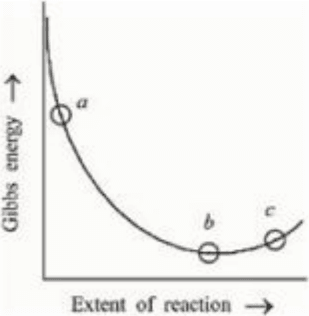
Consider the graph of Gibbs free energy G vs Extent of reaction. The number of statement/s from the following which are true with respect to points (a), (b) and (c) is.................
A. Reaction is spontaneous at (a) and (b)
B. Reaction is at equilibrium at point (b) and non-spontaneous at point (c)
C. Reaction is spontaneous at (a) and non-spontaneous at (c)
D. Reaction is non-spontaneous at (a) and (b)
Your answer stays private
What feels right?
Hint 1 of 3
How does the slope of Gibbs free energy with respect to reaction extent, (∂G/∂ξ)T,P, determine spontaneity?
No score. Commit to your first instinct. We’ll show what your mind noticed and what it missed.
Type the value - units or words beside it are fine.
Step-by-step solutionView
Correct answer
Statements B and C are correct, so the total number of true statements is 2.
Option analysis
Why each option works or fails
Reviewed route
Solution
StepWorking
01given
A plot of Gibbs free energy G vs extent of reaction (ξ). Point (a) is on the downward slope, point (b) is at the local minimum, and point (c) is on the upward slope.
02find
The number of correct statements among A, B, C, and D.
03strategise
The criterion for spontaneity at constant T and P in terms of forward reaction extent is based on the differential change dG:
1. dG<0 (slope <0): Spontaneous (forward direction)
2. dG=0 (slope =0, minimum): Equilibrium
3. dG>0 (slope >0): Non-spontaneous in the forward direction.
04execute
Evaluate each point:
- At point (a): dG<0⟹ Spontaneous.
- At point (b): dG=0⟹ Equilibrium.
- At point (c): dG>0⟹ Non-spontaneous.
Evaluate each statement:
- Statement A: 'Reaction is spontaneous at (a) and (b)' ⟹ False (at (b) it is at equilibrium).
- Statement B: 'Reaction is at equilibrium at point (b) and non-spontaneous at point (c)' ⟹ True.
- Statement C: 'Reaction is spontaneous at (a) and non-spontaneous at (c)' ⟹ True.
- Statement D: 'Reaction is non-spontaneous at (a) and (b)' ⟹ False.
Total true statements = 2.
✓verify
Statements B and C accurately describe points (b), (c), and (a). Total count of correct statements is 2.
Hints that build this answer step by step
How does the slope of Gibbs free energy with respect to reaction extent, (∂G/∂ξ)T,P, determine spontaneity?
Negative slope implies spontaneous forward reaction, zero slope implies equilibrium, and positive slope implies non-spontaneous forward reaction.
What are the signs of the slope of the curve at points (a), (b), and (c)?
Point (a) has a negative slope, point (b) has zero slope (minimum), and point (c) has a positive slope.
Evaluating each given statement: A is false (b is at equilibrium, not spontaneous), B is true, C is true, and D is false. How many total statements are true?
Why is point (b) considered equilibrium rather than spontaneous if it has the lowest free energy?
Spontaneity is determined by the potential to decrease free energy (dG < 0). At the minimum, the slope dG/dξ is 0. This means there is no net driving force in either direction. Therefore, the system is at dynamic chemical equilibrium.