Organic Compounds Containing Oxygen: Chemistry | JEE Main
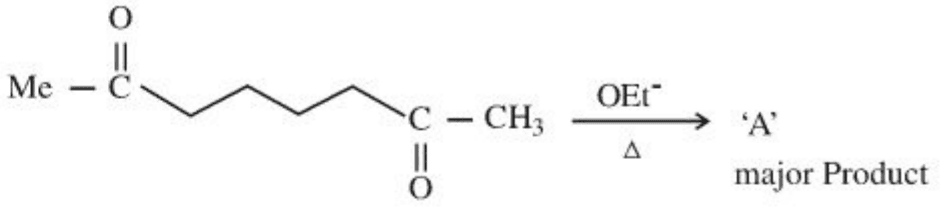
A in the above reaction is :
Your answer stays private
What feels right?
Hint 1 of 2
What transformation does the reagent combination NaBH4/CeCl3 (Luche reagent) specifically perform on an α,β-unsaturated ketone?
No score. Commit to your first instinct. We’ll show what your mind noticed and what it missed.
Step-by-step solutionView
Correct answer
Luche reduction reagents (NaBH4, CeCl3) selectively reduce the carbonyl group of an α,β-unsaturated ketone to an allylic alcohol without reducing the conjugated carbon-carbon double bond.
Option analysis
Why each option works or fails
A ·
Believing that NaBH4/CeCl3 reduces both the carbon-carbon double bond and the carbonyl group to give a fully saturated alcohol. Recognize that the Luche reagent system (CeCl3·7H2O with NaBH4) accelerates 1,2-reduction of the carbonyl while suppressing 1,4-reduction, leaving the C=C double bond intact.
B ·
Believing that the reagent selectively reduces the alkene while leaving the carbonyl group intact. Remember that borohydride reagents deliver hydride to polar carbonyl carbons, not directly to isolated or unactivated C=C bonds.
C ·
This is the correct option: Luche reduction regioselectively carries out 1,2-reduction on α,β-unsaturated ketones to afford allylic alcohols. Identify the CeCl3/NaBH4 combination as the classic Luche reduction, which targets only the ketone carbonyl group.
D ·
Assuming that the reagent completely deoxygenates the ketone down to a methylene group. NaBH4/CeCl3 reduces ketones to secondary alcohols, not hydrocarbons (which would require Clemmensen or Wolff-Kishner conditions).
Reviewed route
Solution
StepWorking
01identify
The reactant is hexane-2,5-dione (an acetonylacetone / 1,4-diketone) in its enol/keto-enol form interacting with P2O5, a powerful dehydrating agent. This is the classic Paal-Knorr furan synthesis.
02mechanism
Hexane-2,5-dione tautomerizes to its bis-enol or mono-enol form: CH3−C(OH)=CH−CH=C(OH)−CH3. Intramolecular nucleophilic attack of one enol oxygen onto the other carbonyl/enol carbon forms a cyclic hemiacetal/dihydrofuran intermediate.
03mechanism
Treatment with P2O5 and heat causes dehydration (loss of a molecule of H2O), generating a fully conjugated, aromatic 5-membered heterocyclic ring containing one oxygen atom.
04product
The resulting compound is 2,5-dimethylfuran, corresponding to Option (2).
✓verify
Check ring size and substituents: 1,4-diketone with 6 carbons yields a 5-membered furan ring with methyl groups at positions 2 and 5. This matches Option (2) exactly.
Hints that build this answer step by step
What transformation does the reagent combination NaBH4/CeCl3 (Luche reagent) specifically perform on an α,β-unsaturated ketone?
Selective 1,2-reduction of the ketone to yield an allylic alcohol
Applying Luche reduction to cyclohex-2-en-1-one, what is the structure of product A?
Cyclohex-2-en-1-ol (retaining the double bond, ketone converted to -OH)
Why does a 1,4-diketone cyclize with P2O5 instead of just dehydrating linearly?
The intramolecular cyclization of a 1,4-diketone produces a stable, aromatic 5-membered furan ring (Paal-Knorr synthesis), which is thermodynamically favored over linear elimination.