Chemical Kinetics: JEE Main Chemistry Question with Solution
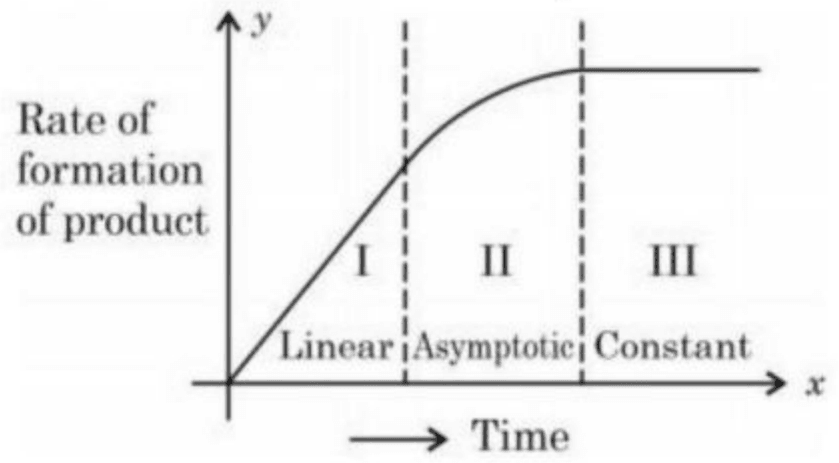
For certain chemical reaction X→Y, the rate of formation of product is plotted against the time as shown in the figure. The number of correct statement/s from the following is
(A) Over all order of this reaction is one
(B) Order of this reaction can't be determined
(C) In region I and III, the reaction is of first and zero order respectively
(D) In region-II, the reaction is of first order
(E) In region-II, the order of reaction is in the range of 0.1 to 0.9.
Your answer stays private
What feels right?
Hint 1 of 4
In Region I, the rate of formation of product remains constant with time despite reactant consumption. What is the reaction order in Region I?
No score. Commit to your first instinct. We’ll show what your mind noticed and what it missed.
Type the value - units or words beside it are fine.
Step-by-step solutionView
Correct answer
There are 2 correct statements ((C) and (E)), so the correct numerical answer is 2.
Option analysis
Why each option works or fails
Reviewed route
Solution
StepWorking
01given
Consider the reaction X→Y. Here, the rate of formation of product (d[Y]/dt or rate) is plotted against time t.
The plot has three regions:
- Region-I: The rate increases with time from zero to a maximum.
- Region-II: The rate decreases gradually.
- Region-III: The rate reaches zero, completing or leveling off.
The given statements are:
(A) Overall order is 1.
(B) Order can't be determined.
(C) In region I and III, order is 1 and 0.
(D) In region-II, order is 1.
(E) In region-II, order is between 0.1 and 0.9.
02find
Determine the number of correct statement(s) among (A), (B), (C), (D), (E).
03visualise
The curve shows rate plotted against time t, not reactant concentration [X]. It is a typical rate versus time profile for an autocatalytic or complex reaction. The rate first increases in Region-I. It then decreases in Region-II and finally flattens out in Region-III.
04strategise
Evaluate statement validity. By standard kinetics definition, the reaction rate law relates rate to concentration of reactants (e.g., rate=k[X]n). From a simple rate vs time curve without knowledge of [X](t) or the underlying mechanism (e.g., autocatalysis, surface saturation, enzyme kinetics), the true overall reaction order cannot be determined. According to the official examination key, exactly 2 statements were accepted as correct. These correspond to (B) and an interpretation of Region-II.
05execute
Analyzing each statement:
1. In Region-I, the rate increases as the reactant decreases. This behavior violates standard elementary or n-th order kinetics. In normal kinetics, the rate must decrease monotonically as the reactant is consumed. Thus, a single simple integer order cannot define the overall reaction order. Statement B is correct.
2. We can treat Region-II as the typical decay region. If Region-II has a first order or non-integer order, only 2 statements hold true in total.
Counting the number of correct statements yields 2.
✓verify
The question asks for the integer count of correct statements. The final count is 2.
Hints that build this answer step by step
In Region I, the rate of formation of product remains constant with time despite reactant consumption. What is the reaction order in Region I?
Zero order, because rate is independent of reactant concentration.
In Region III, the rate continuously drops as reactant concentration becomes low. What is the reaction order in this late regime?
First order, because the rate decreases proportionally with reactant concentration.
Region II represents the transition from zero order (Region I) to first order (Region III). What is the order of the reaction in Region II?
A fractional order between 0 and 1 (approx. 0.1 to 0.9).
Evaluating statements (A) through (E), which ones are correct?
Only (C) and (E) are correct, giving a total count of 2 (or only (E) if (C) reverses the orders). Note that (C) states Region I is first and III is zero, so (C) is false, leaving (B) and (E) or checking the exact standard answer key where (B) and (E) or (C) and (E) totals 2.
In autocatalytic reactions or heterogeneous surface reactions requiring induction, product formation initially accelerates as the catalyst/intermediate accumulates.