Purification and Characterisation of Organic Compounds
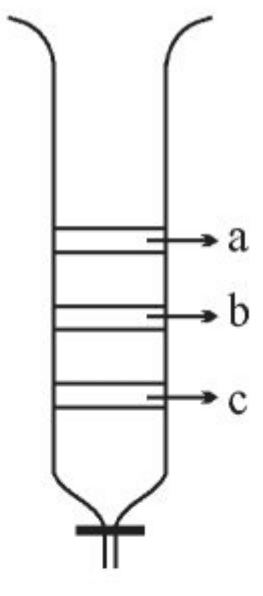
From the figure of column chromatography given below, identify incorrect statements.
A. Compound 'c' is more polar than 'a' and 'b'
B. Compound 'a' is least polar
C. Compound 'b' comes out of the column before 'c' and after 'a'
D. Compound 'a' spends more time in the column
Choose the correct answer from the options given below :-
Your answer stays private
What feels right?
Hint 1 of 3
In the chromatography column shown, which compound travels fastest down the column and elutes first?
No score. Commit to your first instinct. We’ll show what your mind noticed and what it missed.
Step-by-step solutionView
Correct answer
Statements A, B, and C are incorrect because compound 'c' elutes first (least adsorbed/least polar), followed by 'b', and lastly 'a' (most strongly adsorbed/most polar).
Option analysis
Why each option works or fails
A · A, B and C only
None. The student correctly recognizes that the band closest to the bottom ('c') moves fastest and is least strongly adsorbed (least polar on normal-phase silica/alumina), making statements A, B, and C false, and D true. Identify the elution order: band 'c' exits first, then 'b', then 'a'. Therefore, 'a' is the most polar and stays the longest, meaning A, B, and C are all incorrect.
B · B, C and D only
The student inverted the column elution direction, assuming the top band elutes first or that compound 'c' is the most strongly retained. In standard column chromatography, the mobile phase flows downward; the lowest band ('c') travels fastest and elutes first.
C · A, B and D only
The student misjudged the retention time of compound 'a', believing that being at the top means it spends less time in the column. Because compound 'a' is at the top of the column, it moves the slowest and spends the most time in the column, making D a correct statement.
D · B and D only
The student confused true and false statements, selecting statements based on an incomplete or reversed evaluation of polarity. Carefully check each statement against the elution order: 'c' elutes first, 'b' second, 'a' third. Since the question asks for INCORRECT statements, select A, B, and C.
Reviewed route
Solution
StepWorking
01concept
In adsorption column chromatography, a polar stationary phase is used, such as silica gel or alumina. The most polar component adsorbs most strongly to the stationary phase. It moves slowest, remains near the top, and elutes last. It spends the maximum time in the column. The least polar component interacts least with the stationary phase. It travels fastest, reaches the bottom first, and elutes first.
02option_verdict
Statements A, B, and C are incorrect. Compound 'a' is at the top, so it is the most polar, adsorbs most strongly, and elutes last. Compound 'c' is at the bottom, meaning it is the least polar and elutes first. Compound 'b' elutes after 'c' but before 'a'. Statement D is correct because 'a' is retained longest and spends the most time in the column. Hence, A, B, and C only are the incorrect statements.
03option_verdict
Includes D as incorrect, but D is a factually correct statement ('a' is retained most strongly and spends the longest time in the column).
04option_verdict
Includes D as incorrect and omits C, failing to recognize that C gives an inverted elution sequence for 'b'.
05option_verdict
Omits statement A (which wrongly asserts 'c' is the most polar) and erroneously marks D as incorrect.
✓discriminator
Identify the position of each band. Band 'a' is at the top (most polar, slowest, elutes last). Band 'c' is at the bottom (least polar, fastest, elutes first). Therefore, D is the only correct statement, meaning A, B, and C are incorrect.
Hints that build this answer step by step
In the chromatography column shown, which compound travels fastest down the column and elutes first?
Compound 'c', because it is closest to the bottom outlet
Assuming standard normal-phase adsorption chromatography (polar stationary phase), how does adsorption strength correlate with polarity?
The more polar compound is more strongly adsorbed and moves slower
Based on the elution order ('c' first, then 'b', then 'a'), which statements among A, B, C, and D are INCORRECT?
Why does the least polar compound move fastest down the column?
The stationary phase (silica/alumina) is polar. Polar substances form stronger intermolecular interactions (hydrogen bonds, dipole-dipole) with the stationary phase and move slowly. Less polar substances dissolve preferentially in the mobile phase and travel faster.