Organic Compounds Containing Halogens: Chemistry | JEE Main
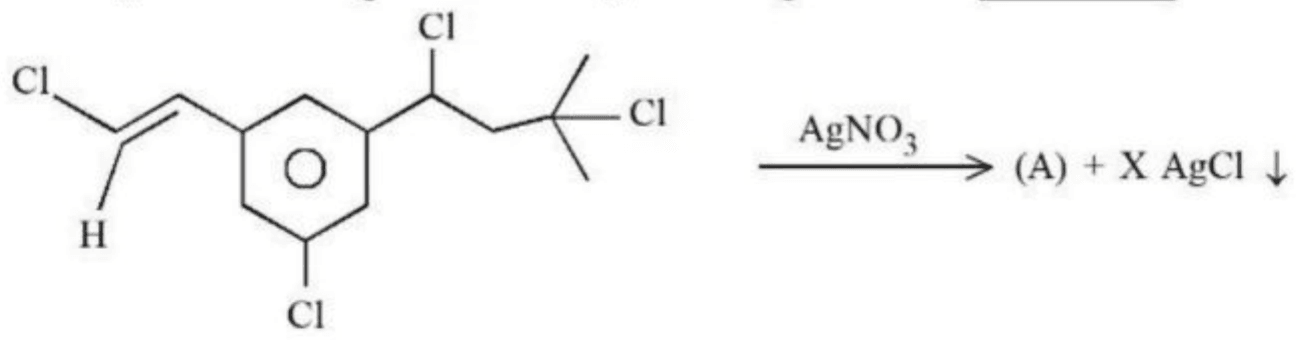
Number of moles of AgCl formed in the following reaction is
Your answer stays private
What feels right?
Hint 1 of 2
Which type of chlorine atoms in an organic substrate are capable of precipitating as AgCl upon treatment with silver nitrate?
No score. Commit to your first instinct. We’ll show what your mind noticed and what it missed.
Type the value - units or words beside it are fine.
Step-by-step solutionView
Correct answer
Two moles of AgCl are formed because only the two labile chlorine atoms readily ionize to form a precipitate with silver ions.
Option analysis
Why each option works or fails
Reviewed route
Solution
StepWorking
01given
A polycyclic organic molecule containing four chlorine atoms at distinct positions (labelled 1 to 4) is treated with excess AgNO3.
02find
Determine the number of moles of AgCl precipitate formed per mole of the given compound.
03strategise
Reaction with AgNO3 proceeds via precipitation of AgCl driven by the generation of a carbocation intermediate (SN1-type cleavage). Assess the feasibility and stability of the carbocation formed upon ionization of chloride at each of the 4 positions.
04execute
Analyze each site individually:
- Position 1: C-Cl is on an alkene carbon. Ionization gives a vinylic carbocation (sp-hybridized, extremely unstable due to high electronegativity of sp carbon). Hence, this Cl− cannot ionize.
- Position 2: C-Cl is directly attached to an aromatic/sp2 ring carbon (aryl/vinylic type). Ionization gives an unstable sp2 phenyl/alkenyl cation, which cannot form under these conditions.
- Position 3: Ionization produces a 2∘ carbocation adjacent to the aromatic/conjugated system (benzylic/allylic resonance stabilization), which is sufficiently stable to form.
- Position 4: Ionization produces a 3∘ bridge/alkyl carbocation stabilized by hyperconjugation and inductive effect, which forms readily.
Therefore, exactly 2 positions (3 and 4) release Cl− to precipitate as AgCl.
Number of moles of AgCl=1+1=2.
✓verify
Vinylic and aryl chlorides are notoriously inert toward AgNO3 due to partial double bond character from resonance and high energy of the resulting cations. Only the benzylic/allylic 2∘ and stable 3∘ positions ionize, confirming 2 moles of AgCl.
Hints that build this answer step by step
Which type of chlorine atoms in an organic substrate are capable of precipitating as AgCl upon treatment with silver nitrate?
Chlorines that can dissociate to generate stable carbocations (such as allylic, benzylic, or tertiary alkyl positions)
How many moles of chloride ions are cleaved from one mole of the substrate to precipitate as AgCl?
Why doesn't Position 1 or 2 react with AgNO3 if AgCl precipitation is thermodynamically very favorable?
Even with Ag+ assisting the leaving group, heterolytic cleavage of a vinylic or aryl C−Cl bond is extremely difficult. It requires forming a vinylic or aryl carbocation. An sp or sp2 carbocation has high electronegativity and poor geometry. Because of this, the activation energy is prohibitively high.