01concept
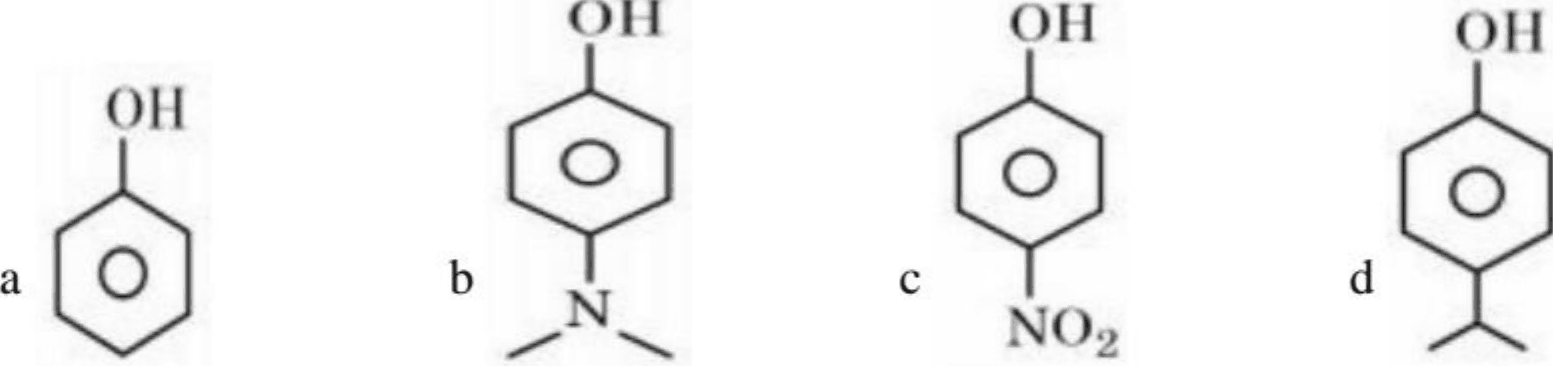
Acidic strength of phenols depends on conjugate base (phenoxide) stability: electron-withdrawing groups (−M,−I) increase acidity, while electron-donating groups (+M,+I,+H) decrease acidity. pKa=−logKa, so pKa∝Acidic strength1. The substituents are: (a) unsubstituted phenol (reference), (b) 4-methoxyphenol (−OCH3 at para gives strong +M>−I), (c) 4-nitrophenol (−NO2 at para gives strong −M,−I), (d) 4-methylphenol (−CH3 at para gives +H,+I).
03option_verdict
Places unsubstituted phenol (a) as less acidic (higher pKa) than 4-methylphenol (d), ignoring that +H/+I of −CH3 destabilizes the phenoxide and decreases acidity below phenol.
04option_verdict
Acidity order is: c (−M of −NO2) > a (phenol reference) > d (+H of −CH3) > b (+M of −OCH3). Therefore, pKa order is the exact inverse: b>d>a>c.
✓discriminator
Identify the extreme ends: −NO2 makes (c) the strongest acid (lowest pKa), and −OCH3 makes (b) the weakest acid (highest pKa). Only Option (2) has b>⋯>c with d>a.