Kinematics: JEE Main Physics Question with Solution
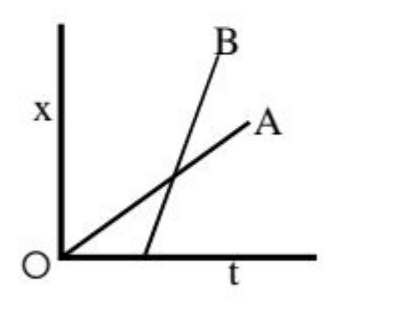
The position-time graphs for two students A and B returning from the school to their homes are shown in figure :
(A) A lives closer to the school
(B) B lives closer to the school
(C) A takes lesser time to reach home
(D) A travels faster than B
(E) B travels faster than A
Choose the correct answer from the options given below :
Your answer stays private
What feels right?
Hint 1 of 2
From the position-time graph, which student lives closer to the school (the origin x=0)?
No score. Commit to your first instinct. We’ll show what your mind noticed and what it missed.
Step-by-step solutionView
Correct answer
Statements (A) and (E) are correct because A's home is at a smaller distance from school (origin) and B's graph has a steeper slope, meaning B travels faster.
Option analysis
Why each option works or fails
A · (A) and (E) only
None. The student correctly interprets distances from the vertical axis intercept/final position and speeds from the slope of the x-t graphs. Correct! A's final position xA<xB means A lives closer to the origin (school), and B's line has a steeper slope, meaning B has a higher speed.
B · (B) and (E) only
The student confuses the home positions of A and B on the position axis, believing B is closer to the origin. Look at the position axis (vertical axis): A's home corresponds to a smaller position value xA compared to B's home xB, so A lives closer to the school.
C · (A), (C) and (E) only
The student assumes that because B starts later or lives farther, A must take less time overall to reach home. Check the time duration Δt=tfinal−tstart for each student from the time axis. B reaches home in a shorter total time interval than A.
D · (A), (C) and (D) only
The student believes a less steep position-time graph represents a higher speed. The slope of a position-time graph (Δx/Δt) represents velocity/speed. Since B's graph has a greater slope than A's graph, B travels faster than A.
Reviewed route
Solution
StepWorking
01concept
On an x-t graph with the origin O representing the school:
1. Distance of home from school is given by the final position coordinate x.
2. Velocity is the slope of the x-t line: v=ΔtΔx.
3. Time taken to reach home is the total duration Δt=tfinal−tstart of travel.
02option_verdict
From the graph, home position xA<xB, so A lives closer to the school (Statement A is TRUE). Slope of B's line is steeper than A's line, so vB>vA, meaning B travels faster than A (Statement E is TRUE). Hence, (A) and (E) only is correct.
03option_verdict
Statement B claims B lives closer to school, which contradicts the graph where xB>xA.
04option_verdict
Statement C claims A takes lesser time to reach home. From the graph, A starts at t=0 and reaches home at tA, while B starts later at t0 and reaches at tB≈tA, meaning B takes time tB−t0<tA. Thus, B takes lesser time, making C false.
05option_verdict
Statement D claims A travels faster than B, which is false since slope of A is less than slope of B.
✓discriminator
Directly compare final x (xA<xB⟹ A is closer) and slope (B is steeper ⟹ B is faster), yielding statements (A) and (E).
✓ Source and academic review↓
Question type
Single correct
Exam relevance
JEE Main · Physics
Concepts assessed
Physics
Academic status
Reviewed by official_key
Source
pyq
Editorial review
3 September 2026
Quick checks
Students also ask
Why does B start after A?
B's position-time line starts at a non-zero time on the time axis, meaning B leaves the school later than A.