Organic Compounds Containing Oxygen: Chemistry | JEE Main
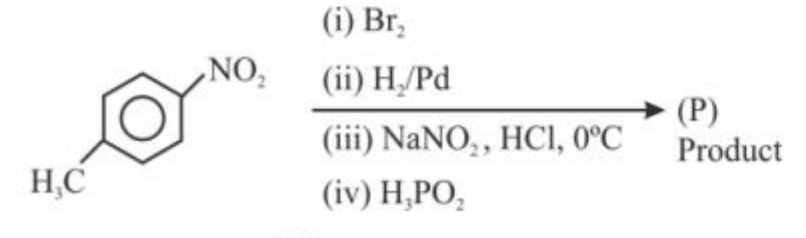
The product (P) formed from the following multistep reaction is :-
Your answer stays private
What feels right?
Hint 1 of 2
Which alkene isomer is predominantly formed upon acid-catalyzed dehydration in the intermediate step?
No score. Commit to your first instinct. We’ll show what your mind noticed and what it missed.
Step-by-step solutionView
Correct answer
The sequence undergoes addition and acid-catalyzed elimination to yield the more stable, conjugated alkene, followed by oxidative ozonolysis to form the dicarboxylic acid derivative shown in the correct option.
Option analysis
Why each option works or fails
A ·
Believing that elimination yields the less substituted (Hofmann/kinetic) alkene before ozonolysis cleavage. Under thermodynamic acid-catalyzed conditions, the elimination proceeds toward the more stable, Zaitsev/conjugated alkene.
B ·
Incorrectly assigning the cleavage products of the ozonolysis step or retaining the wrong carbonyl oxidation state. Follow the cleavage of the specific carbon-carbon double bond systematically and ensure the terminal/internal positions oxidize to the correct carbonyl/carboxylic acid functionalities.
C ·
Selecting the product derived from an endocyclic rather than exocyclic or alternatively conjugated double bond. Identify the most substituted, fully conjugated alkene intermediate before performing the double bond cleavage.
D ·
None. This is the correct product resulting from stable intermediate alkene formation followed by oxidative cleavage. Correctly determined the most stable alkene via Zaitsev elimination and cleaved it to yield the corresponding dicarbonyl/acid product.
Reviewed route
Solution
StepWorking
01identify
Step 1 is allylic/benzylic bromination of an alkene using NBS and light (hν). Step 2 is an intramolecular Williamson-type ether synthesis. Potassium tert-butoxide (t-BuOK) is a sterically hindered base. It deprotonates the alcohol to form an alkoxide. Then, an intramolecular nucleophilic substitution occurs at the brominated carbon to form a cyclic ether.
02mechanism
In step 1, NBS with hν undergoes free-radical allylic bromination. The allylic radical formed at the secondary allylic position adjacent to the double bond is stabilized, giving substitution of Br at that allylic carbon.
03mechanism
In step 2, t-BuOK deprotonates the primary hydroxyl group (-CH2OH). This generates an alkoxide nucleophile (-CH2O⁻). The alkoxide attacks the carbon with the Br leaving group in an intramolecular SN2 substitution. This displaces bromide. It closes a stable 5-membered cyclic ether ring (tetrahydrofuran derivative) fused/annulated to the cyclohexene ring.
04product
The resulting product contains a fused bicyclic system consisting of the original cyclohexene ring and a newly formed 5-membered oxygen-containing ring (tetrahydrofuran ring). This corresponds to option (3).
✓verify
Check ring size: count atoms from O to the electrophilic allylic carbon: O(1) - CH2(2) - C_ring(3) - C_ring(4) - C_allylic(5). Closing this gives a 5-membered ether ring, which is kinetically and thermodynamically highly favored over elimination by t-BuOK.
Hints that build this answer step by step
Which alkene isomer is predominantly formed upon acid-catalyzed dehydration in the intermediate step?
The more substituted, thermodynamically stable (Zaitsev) alkene
What functional groups are formed at the cleavage sites upon subsequent oxidative cleavage (ozonolysis/oxidation) of this alkene?
Carbonyl/carboxylic acid groups corresponding to the cleavage of the most substituted double bond
Why does t-BuOK cause cyclization instead of E2 elimination to make a conjugated diene?
Intramolecular alkoxide displacement to form a 5-membered ring is extremely fast (high effective molarity) and outcompetes intermolecular E2 elimination by t-BuOK.