Organic Compounds Containing Oxygen: Chemistry | JEE Main
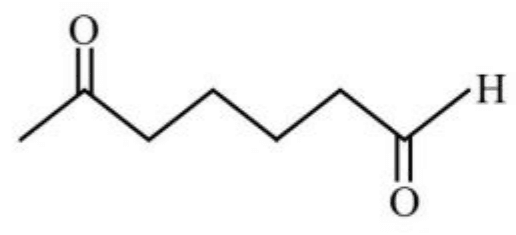
When undergoes intramolecular aldol condensation, the major product formed is :
Your answer stays private
What feels right?
Hint 1 of 2
What ring size is kinetically and thermodynamically favored during the intramolecular aldol condensation of this dicarbonyl compound?
No score. Commit to your first instinct. We’ll show what your mind noticed and what it missed.
Step-by-step solutionView
Correct answer
The reaction proceeds via enolate formation at the less hindered α-carbon followed by nucleophilic attack on the other carbonyl to form a stable 5-membered ring with an α,β-unsaturated enone system as shown in .
Option analysis
Why each option works or fails
A ·
None. This is the correct major product resulting from favorable 5-membered ring formation and conjugation. Form the enolate that yields a stable five-membered ring upon intramolecular nucleophilic attack, followed by dehydration to give the conjugated enone.
B ·
Believing that elimination occurs towards the less substituted or unconjugated position instead of forming the more stable conjugated enone system. Ensure dehydration in aldol condensation yields the thermodynamically preferred α,β-unsaturated carbonyl compound.
C ·
Believing that cyclization forms a strained or less favorable 4-membered ring or incorrect dehydration regiochemistry over the thermodynamically favored 5-membered conjugated product. Compare the ring strain of the possible cyclic intermediates; 5- and 6-membered rings form preferentially over 4-membered rings.
D ·
Believing that intermolecular condensation occurs or that the reaction produces an open-chain or alternative oligomeric structure instead of intramolecular ring closure. Recognize that intramolecular aldol condensation leading to 5- or 6-membered rings is kinetically and entropically favored over intermolecular reactions.
Reviewed route
Solution
StepWorking
01identify
The reaction is a base-catalysed intramolecular aldol condensation of a dicarbonyl substrate to give a stable 5- or 6-membered conjugated cyclic α,β-unsaturated ketone.
02mechanism
Deprotonation occurs at the α-carbon to generate a resonance-stabilized enolate that can nucleophilically attack the other carbonyl group to form a thermodynamically and kinetically favored 5- or 6-membered ring.
03mechanism
The resulting β-hydroxy carbonyl intermediate undergoes dehydration (E1cB elimination of H2O) upon heating to form the conjugated enone system.
04product
The stable cyclic α,β-unsaturated ketone corresponding to Option (0) is obtained as the major product.
✓verify
Verify ring size stability (5- or 6-membered ring preferred over strained 3-, 4-, 7-, or 8-membered rings) and extended conjugation with the carbonyl group.
Hints that build this answer step by step
What ring size is kinetically and thermodynamically favored during the intramolecular aldol condensation of this dicarbonyl compound?
A 5-membered ring formed by enolate attack on the remote carbonyl
Following the intramolecular addition step, which final product is formed after base-catalyzed dehydration (aldol condensation)?
The conjugated α,β-unsaturated cyclic ketone shown in
Why is a 5- or 6-membered ring formed rather than a smaller or larger ring?
5- and 6-membered rings possess minimal angle and torsional strain, making their intramolecular formation kinetically faster and thermodynamically much more stable.