Hydrocarbons: JEE Main Chemistry Question with Solution
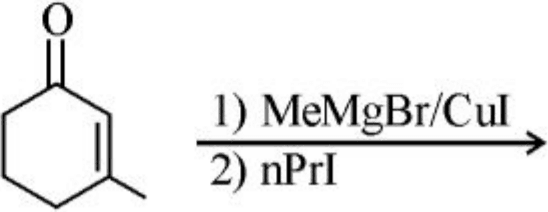
Find out the major product from the following reaction
Your answer stays private
What feels right?
Hint 1 of 2
What mechanism and regiochemical preference govern an elimination using a bulky base such as potassium tert-butoxide (t-BuOK)?
No score. Commit to your first instinct. We’ll show what your mind noticed and what it missed.
Step-by-step solutionView
Correct answer
The sterically hindered base tert-butoxide preferentially abstracts the more accessible proton from the less-substituted carbon, yielding the less-substituted alkene (Hofmann product) as the major product.
Option analysis
Why each option works or fails
A ·
None. This is the correct major product. Bulky bases like potassium tert-butoxide encounter steric hindrance when accessing internal protons, directing deprotonation toward the less hindered terminal or less substituted carbon to favor the Hofmann elimination product.
B ·
Assuming that elimination reactions always favor the more substituted, thermodynamically stable Zaitsev alkene regardless of base bulk. Recognize that potassium tert-butoxide is a sterically bulky base; kinetic deprotonation at the less hindered position dominates over thermodynamic alkene stability.
C ·
Believing that rearrangement of the carbocation occurs prior to elimination, leading to an alternative alkene isomer. Strong bases like tert-butoxide promote concerted E2 elimination without forming a free carbocation intermediate, preventing skeletal rearrangement.
D ·
Confusing substitution with elimination or misidentifying the site of β-elimination across non-adjacent centers. Identify the β-hydrogens adjacent to the halogen-bearing α-carbon and eliminate anti-periplanar H and X across adjacent carbons.
Reviewed route
Solution
StepWorking
01identify
The reaction sequence involves base-induced elimination (E2 dehydrohalogenation or dehydration) on a functionalized methylcyclohexene derivative to yield a cyclohexadiene.
02mechanism
Elimination of the leaving group can occur via multiple β-hydrogens. Proton abstraction leads selectively to the more thermodynamically stable conjugated diene system rather than an isolated or less substituted diene.
03product
The major product formed is the conjugated 1,3-diene with the methyl substituent located on the conjugated double bond system, matching Option (0).
✓verify
Conjugated dienes have extended π-delocalization (resonance energy ~15-20 kJ/mol), making them substantially more stable than non-conjugated (1,4-diene) or exocyclic double bond isomers.
Hints that build this answer step by step
What mechanism and regiochemical preference govern an elimination using a bulky base such as potassium tert-butoxide (t-BuOK)?
E2 mechanism favoring the less substituted (Hofmann) alkene due to steric hindrance during proton abstraction.
Which β-carbon is deprotonated by t-BuO⁻ to yield the Hofmann elimination product?
Why is the conjugated diene preferred over the 1,4-diene?
Conjugated double bonds allow continuous overlap of p-orbitals across all four sp2 carbons, lowering the overall energy through resonance stabilization.