Current Electricity: JEE Main Physics Question with Solution
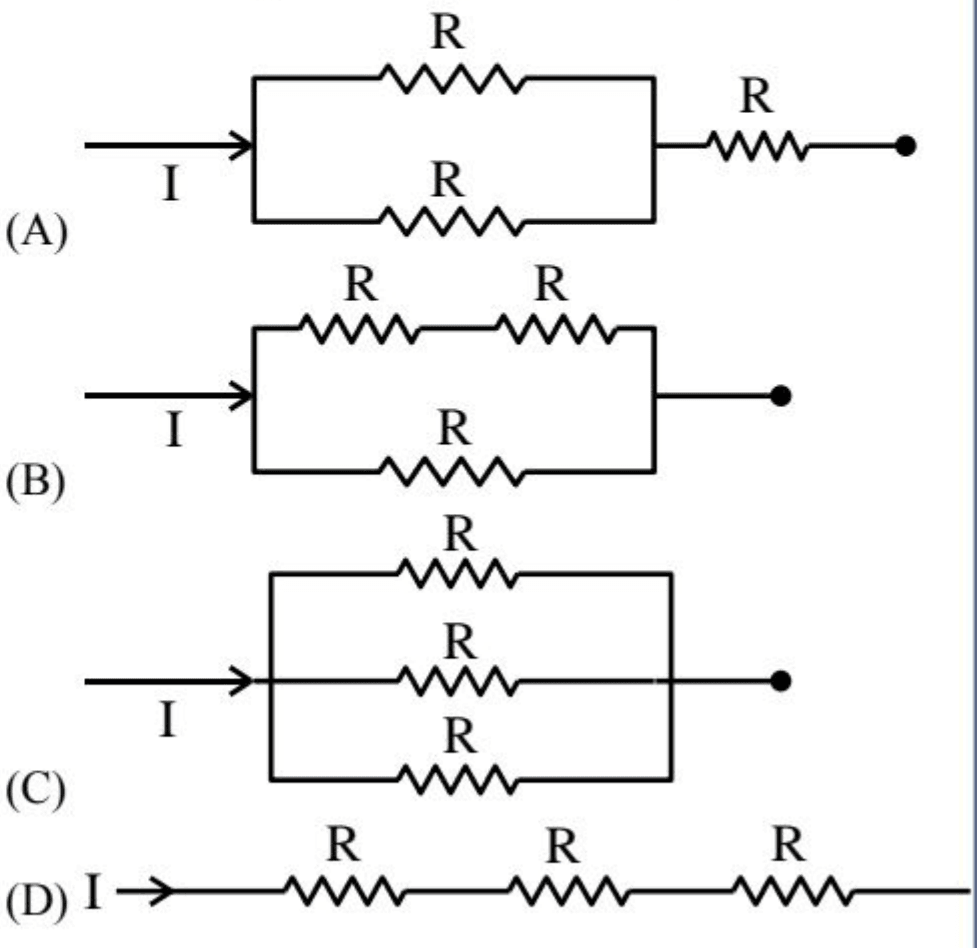
Different combination of 3 resistors of equal resistance R are shown in the figures.
The increasing order for power dissipation is:
Your answer stays private
What feels right?
Hint 1 of 3
For multiple circuits connected to the same voltage source V, how is the total dissipated power P related to the equivalent resistance Req?
No score. Commit to your first instinct. We’ll show what your mind noticed and what it missed.
Step-by-step solutionView
Correct answer
For a constant applied voltage V, power dissipation P=ReqV2 is inversely proportional to equivalent resistance, giving the order PC<PB<PA<PD.
Option analysis
Why each option works or fails
A · PA<PB<PC<PD
Assumes that power dissipation is directly proportional to equivalent resistance (P∝Req) rather than inversely proportional (P∝1/Req) under a constant voltage source. When circuits are connected across the same potential difference V, use P=ReqV2, which means higher equivalent resistance results in lower total power dissipation.
B · PC<PD<PA<PB
Incorrectly evaluates the equivalent resistance of the series-parallel combinations, misranking circuits A and B relative to D. Calculate Req systematically: RA=32R, RB=23R, RC=3R, and RD=3R.
C · PB<PC<PD<PA
Mixes up the formula for power with constant current (P=I2R) instead of constant voltage (P=V2/R), leading to an inverted ranking. Since the potential difference across each whole circuit is fixed to the same voltage source V, the total power is strictly P=ReqV2.
D · PC<PB<PA<PD
None. This is the correct option. Correctly determines the equivalent resistances (RC=3R>RB=1.5R>RA≈0.67R>RD≈0.33R) and inverts the order for power: PC<PB<PA<PD.
Reviewed route
Solution
StepWorking
01given
Three identical resistors each of resistance R are connected in 4 configurations with the same input current I entering each combination:
(A) Two in parallel with one in series: RA=R+2R=23R
(B) Two in series in parallel with one: RB=2R+R2R⋅R=32R
(C) All three in parallel: RC=3R
(D) All three in series: RD=3R
02find
The increasing order of power dissipation among configurations A, B, C, and D.
03strategise
Since current I enters each network, the total power dissipated in each circuit is P=I2Req. Thus, P∝Req. The increasing order of power directly follows the increasing order of equivalent resistance.
04execute
Comparing the equivalent resistances:
RC=31R≈0.33RRB=32R≈0.67RRA=23R=1.5RRD=3R
Therefore, RC<RB<RA<RD, which implies PC<PB<PA<PD.
✓verify
All-parallel always gives the minimum resistance, and all-series gives the maximum. The mixed circuits naturally sit in between with 2R/3<3R/2. Hence PC<PB<PA<PD is logically sound.
Hints that build this answer step by step
For multiple circuits connected to the same voltage source V, how is the total dissipated power P related to the equivalent resistance Req?
P=ReqV2, so P is inversely proportional to Req
What are the equivalent resistances RA,RB,RC,RD for the four configurations?
RA=32R,RB=23R,RC=3R,RD=31R
Given RC=3R>RB=1.5R>RA≈0.67R>RD≈0.33R, what is the increasing order of power dissipation?
The diagram indicates current I entering and leaving each network. Because I is the common given quantity across all circuits, P=I2Req directly relates P to Req.