Organic Compounds Containing Oxygen: Chemistry | JEE Main
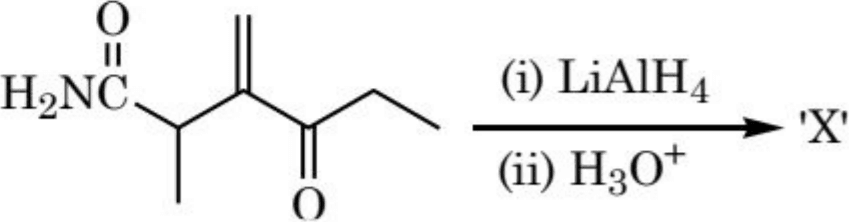
In the reaction give below:
The product 'X' is:
Your answer stays private
What feels right?
Hint 1 of 2
What type of reaction is occurring, and which rule governs the major product's regiochemistry?
No score. Commit to your first instinct. We’ll show what your mind noticed and what it missed.
Step-by-step solutionView
Correct answer
The reaction produces the more substituted, thermodynamically stable alkene (Zaitsev product) via base-induced elimination.
Option analysis
Why each option works or fails
A ·
None. This is the correct product. Elimination follows Zaitsev's rule under standard conditions to yield the more stable, more substituted alkene as the major product.
B ·
Believing that deprotonation occurs preferentially at the less sterically hindered carbon (Hofmann elimination) despite non-bulky conditions. Check the base and leaving group: unless a bulky base or a bulky/charged leaving group is used, elimination favors the more substituted Zaitsev alkene.
C ·
Assuming that a kinetic or rearranged regioisomer is favored over the conjugated/more substituted double bond. Identify all accessible β-hydrogens and compare the thermodynamic stability of the resulting alkenes, favoring the more substituted double bond.
D ·
Confusing the elimination regiocenter with an alternative elimination pathway that yields a less substituted alkene. Determine the degree of substitution of each possible alkene product; the most substituted alkene is the major thermodynamic product under Zaitsev conditions.
Reviewed route
Solution
StepWorking
01identify
The reactant is 2-(1-hydroxyethyl)cyclohexanone, a β-hydroxy ketone.
The reaction involves heating with an acid catalyst (H+ / Δ). This condition promotes dehydration (loss of water). The final product is an α,β-unsaturated carbonyl compound.
02mechanism
Protonation of the hydroxyl oxygen forms an alkyloxonium ion: -CH(OH2+)CH3. Loss of H2O yields a secondary carbocation on the side chain: -CH(+)CH3. Deprotonation can occur either from the adjacent methyl carbon or from the α-carbon of the cyclohexane ring (C2). Deprotonation at C2 is favoured because it generates an alkene directly conjugated with the carbonyl group (C=O), yielding an extended conjugated system.
03product
Elimination yields 2-ethylidenecyclohexan-1-one, where the double bond is formed between the ring carbon (C2) and the exocyclic ethylidene carbon (C=CH-CH3). This corresponds to Option (0).
✓verify
Check conjugative stability. An α,β-unsaturated ketone is thermodynamically more stable than an unconjugated alkene (Option 2). It is also more stable than an endocyclic double bond that is not fully conjugated with the preserved carbonyl (Option 3).
Hints that build this answer step by step
What type of reaction is occurring, and which rule governs the major product's regiochemistry?
An elimination reaction yielding the more substituted alkene according to Zaitsev's rule
Between the competing β-elimination pathways, which leads to product 'X'?
Removal of a proton from the more substituted β-carbon to generate the more substituted, stable double bond
Why doesn't dehydration form an endocyclic double bond inside the ring?
The OH group is located on the exocyclic carbon (side chain). Dehydration eliminates this OH group. It also removes an H from the α-carbon of the ring. This forms an exocyclic double bond that conjugates directly with the C=O group.