Organic Compounds Containing Oxygen: Chemistry | JEE Main
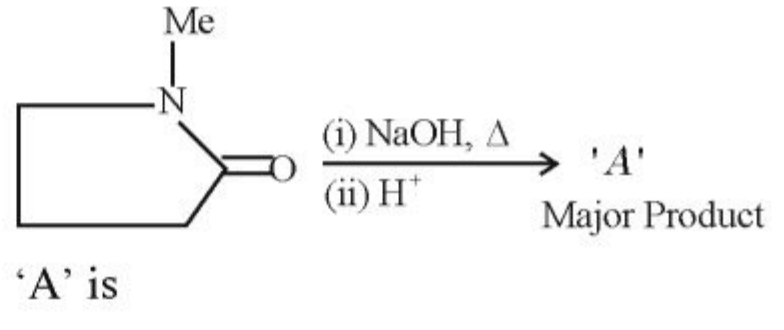
In the reaction given below
'A' is
Your answer stays private
What feels right?
Hint 1 of 2
What stereoelectronic requirement must be satisfied for an E2 elimination to occur in a cyclohexane ring?
No score. Commit to your first instinct. We’ll show what your mind noticed and what it missed.
Step-by-step solutionView
Correct answer
Under E2 elimination conditions with an unhindered base, trans-diaxial anti-periplanar geometry dictates the formation of the more substituted, thermodynamic alkene (Zaitsev product).
Option analysis
Why each option works or fails
A ·
None. This is the correct product. Elimination occurs between the axial leaving group and an adjacent anti-periplanar axial proton to form the thermodynamically more stable, more substituted alkene.
B ·
Believing the reaction selectively favors the less substituted double bond despite the availability of an anti-periplanar proton at the more substituted beta-carbon. Identify all beta-carbons with anti-periplanar axial hydrogens; when multiple anti-periplanar pathways exist, an unhindered base yields the more substituted Zaitsev alkene.
C ·
Assuming that elimination occurs toward a non-adjacent position or misidentifying the regiochemical outcome of the beta-elimination. Ensure that the double bond forms specifically between the alpha carbon carrying the leaving group and an adjacent beta carbon possessing an anti-periplanar hydrogen.
D ·
Confusing kinetic Hofmann-type elimination with thermodynamic Zaitsev elimination under unhindered base conditions. Check the steric bulk of the base and anti-periplanar requirements; a small base abstracts the proton leading to the more stable, highly substituted double bond.
Reviewed route
Solution
StepWorking
01identify
The reactant is a β-hydroxy ketone (specifically 4-hydroxy-4-methylpentan-2-one, diacetone alcohol). The reagent is concentrated H2SO4 with heat (Δ), indicating an acid-catalysed dehydration (E1cB-like/E1 elimination) to form an α,β-unsaturated carbonyl compound.
02mechanism
Protonation of the tertiary hydroxyl group by H2SO4 yields an oxonium ion: -C(CH3)2-OH2+. Loss of a water molecule produces a tertiary carbocation intermediate: CH3-C(=O)-CH2-C+(CH3)2.
03mechanism
Elimination of a proton can occur from two positions. It can leave from the α-methylene group (-CH2-) or from one of the methyl groups of the -C(CH3)2 center. Deprotonation from the -CH2- carbon is highly favored. This forms a double bond conjugated with the adjacent carbonyl group (C=O). The product is 4-methylpent-3-en-2-one (mesityl oxide). This product is thermodynamically very stable due to resonance conjugation.
04product
The major product 'A' is 4-methylpent-3-en-2-one: CH3-C(=O)-CH=C(CH3)2, matching Option (0).
✓verify
Check stability: Conjugated alkene (α,β-unsaturated ketone) has extensive resonance stabilization compared to the non-conjugated terminal alkene or unconjugated isomers. This confirms Option (0) as the correct major product.
Hints that build this answer step by step
What stereoelectronic requirement must be satisfied for an E2 elimination to occur in a cyclohexane ring?
The leaving group and the beta-hydrogen must both be in axial positions (anti-periplanar).
When multiple adjacent beta-carbons have anti-periplanar axial hydrogens, which alkene product predominates with an unhindered base?
The more substituted, thermodynamically stable alkene (Zaitsev product).
Why does elimination occur from the -CH2- carbon instead of the methyl carbons attached to the tertiary center?
Deprotonation at the methylene carbon produces an α,β-unsaturated ketone, where the new C=C double bond is in resonance conjugation with the C=O group. Conjugation imparts substantial thermodynamic stability.