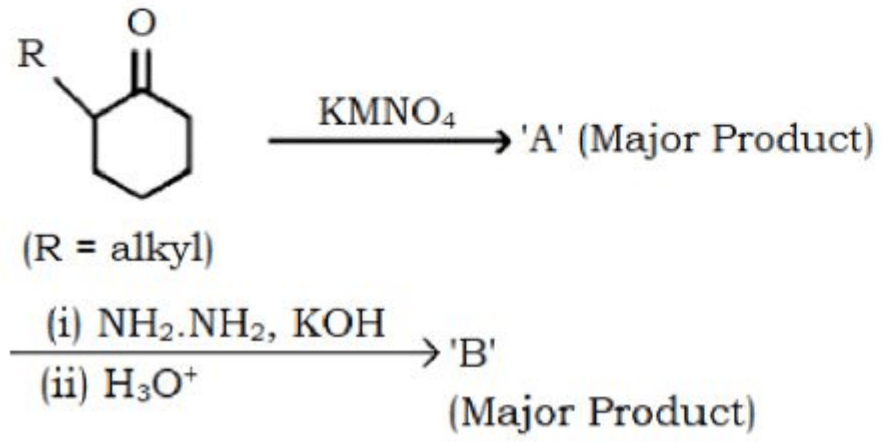
Oxidative Cleavage and Wolff-Kishner Reduction of Cyclohexanones

What feels right?
No score. Commit to your first instinct. We’ll show what your mind noticed and what it missed.

No score. Commit to your first instinct. We’ll show what your mind noticed and what it missed.
Correct answer
Option analysis
Belief that Wolff-Kishner reduction reduces carboxylic acid groups to alkanes while leaving ketone groups intact. Wolff-Kishner reduction selectively reduces aldehydes and ketones to methylene groups () and does not reduce carboxylic acid carbonyls.
Belief that the initial oxidation step cleaves a carbon-carbon single bond away from the functionalized site without affecting the ketone. Oxidation of cyclohexanone derivatives typically cleaves the ring at the -position relative to the carbonyl group, generating a keto-acid intermediate.
Belief that the Wolff-Kishner reduction step converts a carboxylic acid group to an alcohol or aldehyde instead of reducing the ketone to a methylene group. The hydrazone intermediate forms at the ketone carbonyl, which is then reduced to a group under strongly basic conditions, while the carboxylic acid remains intact as a carboxylate salt.
Correctly identifies that oxidative cleavage of the cyclohexanone derivative produces a keto-acid (A), and subsequent Wolff-Kishner reduction converts the ketone carbonyl to a methylene group to yield the alkyl-substituted carboxylic acid (B).
The reaction sequence begins with oxidative cleavage of 2-alkylcyclohexanone by hot, concentrated (Popoff's rule / enol cleavage), followed by Wolff-Kishner reduction () of product 'A'.
2-Alkylcyclohexanone tautomerizes to its more substituted, thermodynamically more stable enol form: 2-alkylcyclohex-1-en-1-ol. Oxidative cleavage of the double bond using splits the bond. The carbon bearing the alkyl group is converted into a keto carbonyl group (), while the enolic carbon oxidizes fully to a carboxylic acid group (). Thus, product 'A' is 6-oxo-alkanoic acid: .
Product 'A' contains both a ketone carbonyl group and a carboxylic acid group. Reaction with hydrazine in alkaline medium () reduces the ketone carbonyl group selectively to a methylene group () via Wolff-Kishner reduction. The carboxylic acid group is unaffected by Wolff-Kishner reduction and remains intact as a carboxylate salt, which on acidic workup () yields the free carboxylic acid: .
Product 'A' is and product 'B' is , exactly matching Option D.
Check carbon count: the original ring has 6 carbons + alkyl group R. Product 'A' has 1 (keto) + 4 (methylenes) + 1 (acid) = 6 carbons in the main chain plus R. Product 'B' has 5 (methylenes) + 1 (acid) = 6 carbons in the main chain plus R. Total carbons and functional group regiochemistry are preserved correctly.
Quick checks
Ketones undergo oxidation via their enol intermediate. The more substituted enol has the double bond between C1 and C2, bearing the R substituent. This enol is more stable according to Zaitsev-like stability rules. Therefore, oxidative cleavage predominantly cleaves that C=C bond according to Popoff's rule.