Principles Related to Practical Chemistry: Chemistry | JEE Main
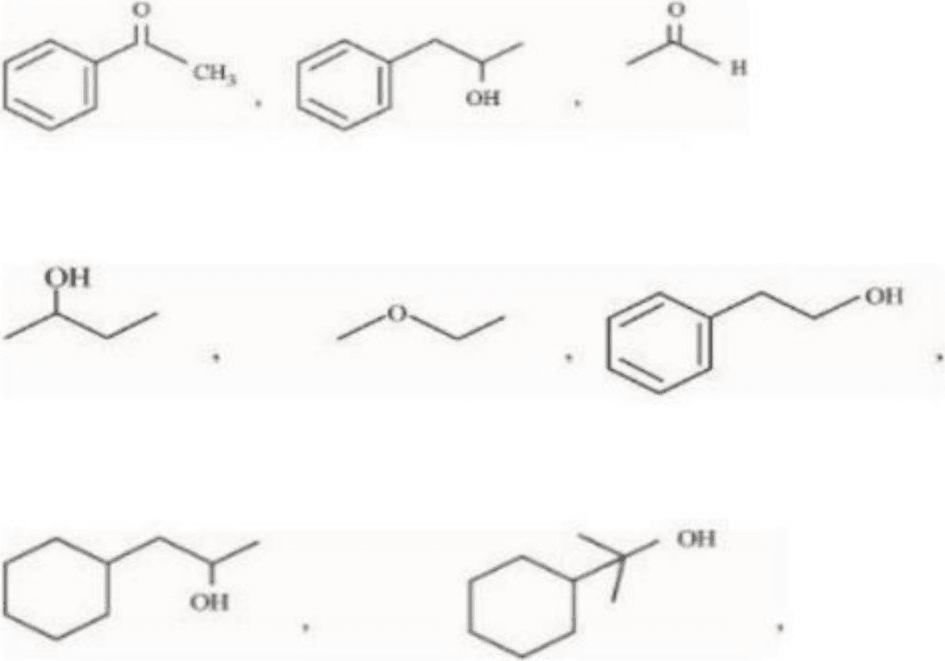
Number of compounds giving (i) red colouration with ceric ammonium nitrate and also (ii) positive iodoform test from the following is
Your answer stays private
What feels right?
Hint 1 of 3
What functional group feature is necessary to produce a red colouration with ceric ammonium nitrate (CAN)?
No score. Commit to your first instinct. We’ll show what your mind noticed and what it missed.
Type the value - units or words beside it are fine.
Step-by-step solutionView
Correct answer
Three compounds contain the required secondary alcohol structure containing a methyl group, CH3CH(OH)−, giving both a red coloration with ceric ammonium nitrate and a positive iodoform test.
Option analysis
Why each option works or fails
Reviewed route
Solution
StepWorking
01given
A set of organic compounds containing alcohol/carbonyl groups tested with: (i) Ceric ammonium nitrate (CAN) giving a red colouration, and (ii) Iodoform test (I2/NaOH) giving a positive yellow precipitate.
02strategise
1. CAN test: Alcohols (primary, secondary, or tertiary aliphatic/alicyclic alcohols) react with CAN to give a red complex Ce(IV) alkoxy complex. (Phenols generally give brown/black colours or precipitate, not the characteristic red coloration of alcohols).
2. Iodoform test: Requires a methyl carbonyl group (CH3C=O) or a methyl carbinol group (CH3CH(OH)−R, where R=H, alkyl, or aryl).
3. Thus, a compound meeting BOTH criteria must have an alcoholic group (for CAN test) AND specifically the CH3CH(OH)− group (for iodoform test). Carbonyl compounds with CH3C=O lack the alcoholic -OH group and fail the CAN test unless an alcohol is also present.
03execute
Screen each given structure:
1. Ethanol (CH3CH2OH): Alcoholic -OH (passes CAN) + contains CH3CH(OH)H (passes iodoform) → YES (1).
2. 2-Propanol / Isopropanol (CH3CH(OH)CH3): Secondary alcohol (passes CAN) + contains CH3CH(OH)− (passes iodoform) → YES (2).
3. 1-Phenylethanol (Ph-CH(OH)CH3): Secondary alcohol (passes CAN) + contains CH3CH(OH)Ph (passes iodoform) → YES (3).
4. Other species such as methanol, acetone, acetophenone, or tertiary alcohols either fail the iodoform test (e.g., methanol, t-butanol) or fail the CAN test (e.g., ketones like acetone/acetophenone lack the alcoholic -OH). Total count = 3.
✓verify
Total count is 3 compounds containing the secondary or primary methyl carbinol moiety CH3CH(OH)−. All three have an alcoholic -OH (CAN positive) and the oxidisable methyl carbinol group (iodoform positive).
Hints that build this answer step by step
What functional group feature is necessary to produce a red colouration with ceric ammonium nitrate (CAN)?
An alcoholic hydroxy group (−OH)
To give BOTH a positive CAN test (red colour) and a positive iodoform test, what specific structural unit must the compound possess?
CH3−CH(OH)−
Counting only the structures containing the CH3−CH(OH)− unit among the given set, what is the total number of valid compounds?
No, ceric ammonium nitrate (CAN) is a characteristic qualitative reagent for alcohols, which form a red-coloured cerate alkoxy complex. Simple carbonyl compounds like ketones do not give this red colour.