Atoms and Nuclei: JEE Main Physics Question with Solution
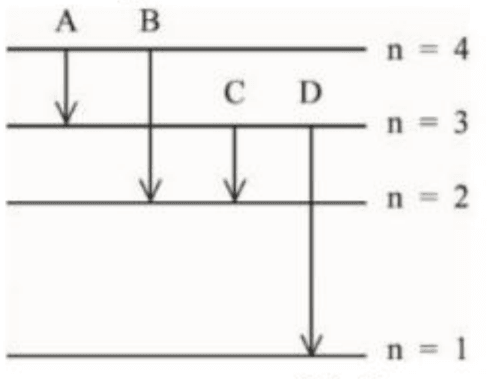
The energy levels of an hydrogen atom are shown below. The transition corresponding to emission of shortest wavelength is
Your answer stays private
What feels right?
Hint 1 of 2
How is the wavelength λ of an emitted photon related to the energy difference ΔE between the two levels?
No score. Commit to your first instinct. We’ll show what your mind noticed and what it missed.
Step-by-step solutionView
Correct answer
The transition with the shortest wavelength corresponds to the greatest energy difference in emission, which is transition D from n=5 to n=1.
Option analysis
Why each option works or fails
A · C
Believing that the transition between the highest numbered adjacent levels gives the shortest wavelength because the energy level index is highest. Recognize that photon energy is inversely proportional to wavelength (E=hc/λ), so the shortest wavelength requires the maximum energy difference ΔE, not adjacent high-n transitions where levels are tightly packed.
B · D
Correct option. Transition D is an emission jump from n=5 directly to the ground state n=1, yielding ΔE=−0.54 eV−(−13.6 eV)=13.06 eV, the largest energy release and thus the shortest wavelength. None needed.
C · B
Assuming that a smaller energy jump corresponds directly to a shorter wavelength, confusing proportionality between energy and wavelength. Recall that λ=hc/ΔE. As ΔE increases, λ decreases, meaning the smallest energy gap produces the longest wavelength, not the shortest.
D · A
Thinking transition A (n=2 to n=1) represents the highest energy emission without checking whether transitions from higher states to n=1 release more energy. Compare ΔE across all downward transitions: n=5→n=1 (transition D) releases 13.06 eV, which exceeds the 10.2 eV released by n=2→n=1 (transition A).
Reviewed route
Solution
StepWorking
01concept
For a radiative transition emitting a photon of wavelength λ, energy conservation gives ΔE=λhc, which implies λ=ΔEhc. Therefore, the emission transition with the shortest wavelength corresponds to the transition having the maximum energy difference ΔE directed from a higher energy state to a lower energy state.
02option_verdict
Transition C corresponds to an upward transition from n=1 to n=2, which represents absorption rather than emission. The energy change is 10.2 eV, which is smaller than 12.09 eV.
03option_verdict
Transition D is a downward emission transition from n=3 (−1.51 eV) to n=1 (−13.6 eV). The energy of the emitted photon is ΔE=−1.51−(−13.6)=12.09 eV. This is the maximum energy difference among all given emission transitions, yielding the shortest wavelength λ=12.09 eVhc.
04option_verdict
Transition B is an emission transition from n=2 (−3.4 eV) to n=1 (−13.6 eV) with ΔE=10.2 eV, which is less than the energy difference of transition D (12.09 eV), so it emits a longer wavelength.
05option_verdict
Transition A is an emission transition from n=3 (−1.51 eV) to n=2 (−3.4 eV) with ΔE=1.89 eV, which has the smallest energy gap and hence the longest wavelength.
✓discriminator
Shortest wavelength means maximum photon energy in emission (downward arrow). Transition D drops all the way from n=3 to n=1, covering the largest energy gap (12.09 eV), so it must be D.
Hints that build this answer step by step
How is the wavelength λ of an emitted photon related to the energy difference ΔE between the two levels?
λ=ΔEhc, so the shortest wavelength corresponds to the largest energy gap.
Which downward transition in the hydrogen atom energy diagram results in the largest energy difference ΔE?