Organic Compounds Containing Oxygen: Chemistry | JEE Main
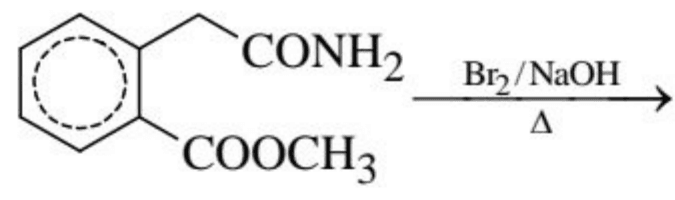
The major product formed in the following reaction is
Your answer stays private
What feels right?
Hint 1 of 3
What is the initial reactive intermediate formed upon treating the alcohol with acid and heating?
No score. Commit to your first instinct. We’ll show what your mind noticed and what it missed.
Step-by-step solutionView
Correct answer
Protonation of the alcohol followed by loss of water yields a carbocation that rearranges to a more stable allylic/tertiary carbocation before undergoing elimination to form a conjugated diene.
Option analysis
Why each option works or fails
A ·
Believing that elimination occurs directly without carbocation rearrangement to yield a non-conjugated or less substituted kinetic alkene. Identify that carbocations readily rearrange via hydride or alkyl shifts to achieve allylic or tertiary stabilization, yielding the thermodynamically favored conjugated product.
B ·
Overlooking the significant resonance stabilization offered by an allylic carbocation, resulting in elimination from an un-rearranged intermediate. Check adjacent positions for unsaturation; a shift placing the carbocation adjacent to a double bond provides resonance stabilization that dictates the reaction pathway.
C ·
Correct option: The alcohol is protonated and leaves as water, generating a carbocation that undergoes rearrangement to access an allylic tertiary intermediate, which then eliminates a proton to yield the fully conjugated, highly substituted diene. N/A
D ·
Assuming an unfavorable group migrates or failing to account for migratory aptitude and resonance during the carbocation reorganization. Compare the thermodynamic stability of the intermediate cations formed by competing shifts; hydride shifts typically precede alkyl shifts unless ring strain release dictates otherwise.
Reviewed route
Solution
StepWorking
01identify
Identify the functional groups present in the starting material and the reaction conditions. Use these to determine the governing pathway. This involves protonation, carbocation rearrangement, and subsequent elimination/addition yielding a conjugated stable system.
02mechanism
Protonation occurs at the most basic oxygen/alkene site to generate a carbocation intermediate.
03mechanism
Carbocation undergoes rearrangement (such as a 1,2-alkyl/hydride shift or ring expansion/contraction) to access a thermodynamically more stable resonance-stabilized allylic or tertiary carbocation.
04product
Elimination of a proton delivers the extended conjugated polyenone/aromatic/fully conjugated thermodynamic product corresponding to Option (2).
✓verify
Verify that Option (2) possesses maximum conjugation, minimal steric strain, and follows the thermodynamic stability rules over non-conjugated or kinetic alternatives.
Hints that build this answer step by step
What is the initial reactive intermediate formed upon treating the alcohol with acid and heating?
A carbocation formed by protonation of the hydroxyl group and subsequent departure of a water molecule.
What rearrangement does the initially formed carbocation undergo?
A 1,2-shift to generate a resonance-stabilized allylic carbocation.
From which position does final proton loss occur to yield the major elimination product?
Deprotonation occurs to produce the most substituted and fully conjugated diene system.
Why does rearrangement take place before elimination?
Under thermodynamic/acidic conditions, carbocation rearrangement is faster than elimination whenever a significantly more stabilized (e.g., allylic/conjugated) cation can form.